
 Trying to add a payment method? You can do this on the

QuickTake:
Wildfire smoke is a complex mix of gases and fine particles from trees and other material that burns. Emerging science suggests it's more hazardous than once believed. But local regulators don't have the data to show what exactly is in the smoke and what that could mean for public health in Eugene and Springfield.
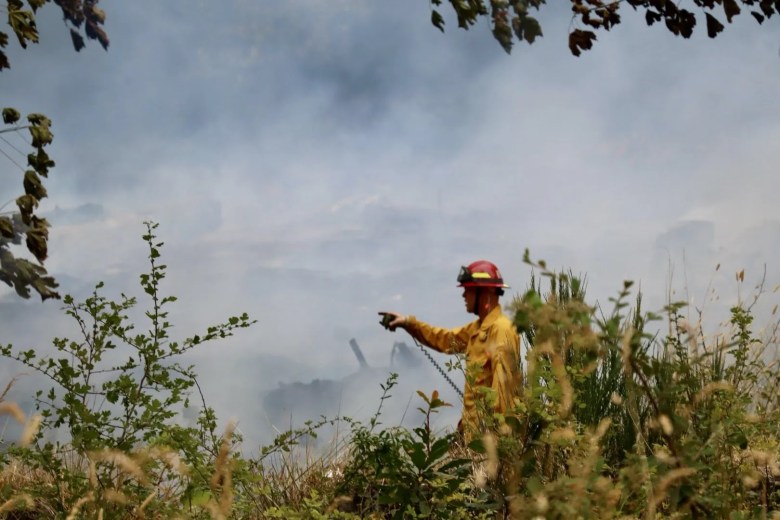
Wildfire smoke marked the summer days in Eugene and Springfield this August.
Sometimes, haze trickled in slowly — as it did the first week of August. Other times, it quickly flowed into the southern Willamette Valley almost like a wall of smoke — as it did Monday, Aug. 31.
Lane Regional Air Protection Agency monitors capture the degradation of air quality, measured on the Air Quality Index scale from zero to 500 and color-coded: the higher the number, the darker the red, the worse the air.
Air quality Monday hit unhealthy levels.
Particulate matter — tiny materials small enough to travel from the lungs and into the bloodstream when inhaled — is a key part of those Air Quality Index readings. (Scientists call that tiny particulate matter PM2.5.)
For decades, when it comes to PM2.5 in wildfire smoke, these particles have been described as dust soot from burning trees. But emerging academic research shows that as fires burn hotter and increasingly in urban areas, the smoke can also include heavy metals and toxic chemicals as buildings and vehicles burn, too.
While Lane Regional Air Protection Agency knows PM2.5 was at dangerous levels multiple times in August, it doesn’t know exactly what is in it or what else the smoke may have contained. The agency’s monitoring network isn’t built to capture such information about wildfire smoke.
That’s contributing to a data gap.
Without the information, state health officials don’t know enough about the makeup of wildfire smoke to say whether some fires are bringing more dangerous particulates into Eugene and Springfield than others.

While Oregon cities such Portland and Medford also experience wildfire smoke, it doesn’t linger the way it does in the Willamette Valley, where wind patterns and surrounding forests can trap smoke for days.
The American Lung Association has ranked Eugene and Springfield No. 2 in the nation for worst short-term particle pollution — pollution that largely comes from wildfire smoke.
Chemical traces in local smoke
While haze persisted throughout the month in Eugene and Springfield, mostly at moderate levels, two notable events darkened the skies.
- Grasshopper Fire: Burning east of Mount Hood, the fire’s smoke settled into the southern Willamette Valley Aug. 3. It stayed at unhealthy levels for four days.
- Austin Fire: Burning south of Mount Hood, the fire’s smoke came with easterly and northerly wind Aug 31. It quickly subsided the following day.
While Lane Regional Air Protection Agency spokesperson Matt Sorensen did not have a specific smoke profile of the events, he shared information that the agency learned during the 2022 Cedar Creek Fire.
Smoke from that fire choked Oakridge for 37 days. In response, the agency placed a monitor there that could capture air toxics.
Data showed elevated levels of benzene and formaldehyde, both chemicals linked to leukemia, according to the American Cancer Society.
The fuel of the Cedar Creek Fire — timber and underbrush — resembles what is burning in the Grasshopper and Austin fires. While the similarity in fuel type offers a sense of what may have been in the August smoke, it is not a direct measurement of what reached Eugene and Springfield.
Collecting such data presents challenges, both financially and logistically, Sorensen said in an email to Lookout Eugene-Springfield. The Department of Environmental Quality, which partners with Lane Regional Air Protection Agency on air quality advisories, faces similar constraints.
“Most sites don’t sample for air toxics daily; canister costs, data processing costs, and staff availability for swaps mean they run on set schedules, so a site can miss a significant smoke event if it isn’t collecting that day,” Sorensen said.
The agency’s air monitoring network currently includes just one site dedicated to toxic and hazardous air pollutants. Located in west Eugene, it is designed to track year-round sources such as vehicle and industrial emissions.
“Wildfire smoke continues to be tracked using PM2.5 monitors,” Sorensen said. “That data is then shared with the Oregon Health Authority and other health-focused agencies to assess health impacts.”
Open questions for public health
Historically, public health experts have understood wildfire smoke as a short-term environmental hazard. Now, new science is emerging about its long-term effects and what is in the smoke.
“There is more and more evidence accumulating that there are multiple sources of hazards from wildfire smoke,” said Gabriella Goldfarb, section manager for environmental public health at the Oregon Health Authority, the state’s public health agency.
She pointed to huge fires that have burned through neighborhoods, like the Los Angeles fires in early 2025, and closer to home, the 2020 Oregon fires, which destroyed hundreds of homes in the McKenzie River valley.
“That smoke is different than wildland fire smoke. That can have lead, which wildland smoke is not going to have. But both kinds can have benzene. But we just don’t have the data,” Goldfarb said. “We can’t say what the benzene is doing to you. We just don’t have enough evidence.”
So the agency, she said, relies on the existing evidence, which remains focused on PM2.5. And PM2.5 already has bad health implications: decades of research has linked it to worsening asthma, premature births and increased hospitalizations.

The risk isn’t just about what’s in the smoke, but who’s breathing it, noted Eric Coker, an environmental epidemiologist at the health authority. Children, older adults, pregnant people, and people with heart or lung disease face greatest risk. So do people in lower-income households, which may not have air purifiers or well-insulated homes.
“Wildfire smoke is nothing to be trifled with,” Coker said.
“There’s a lot of questions epidemiologically, health risk-wise that is still to be worked out,” he said. “Does this now become a chronic or long-term exposure scenario for different populations? That’s a whole open question. So, I do want to impress, at the end of the day, we know that there are short-term exposure risks, and we want people to take it seriously.”
Even with the cold front and rain coming into western Oregon, wildfire season is expected to continue through September. On Monday, the 60-acre Deep Creek Fire broke out in Lane County between Blue River and Oakridge, sending a plume of smoke above the Willamette National Forest.
Have something to say?
Send us a Letter to the Editor. Read our guidelines for Letters to the Editor here.

