
 Trying to add a payment method? You can do this on the

There is an art to cutting down a tree. Unfortunately, when Janell and I set out to build a log cabin, it was an art we did not have.
It was 1977, in the back-to-nature era when hippies dreamed of living lightly off the grid. We were college kids with a long summer vacation and access to a patch of roadless timberland my parents had bought in a survivalist panic during the Cold War.
We also had a two-man crosscut saw, an inheritance from the grandfather who’d worked in the Booth-Kelly mill in Wendling in 1919. Today, looking at the saw hanging above the woodstove in our log cabin, which still doesn’t have road access, I’m reminded of how little we knew when we started that project.
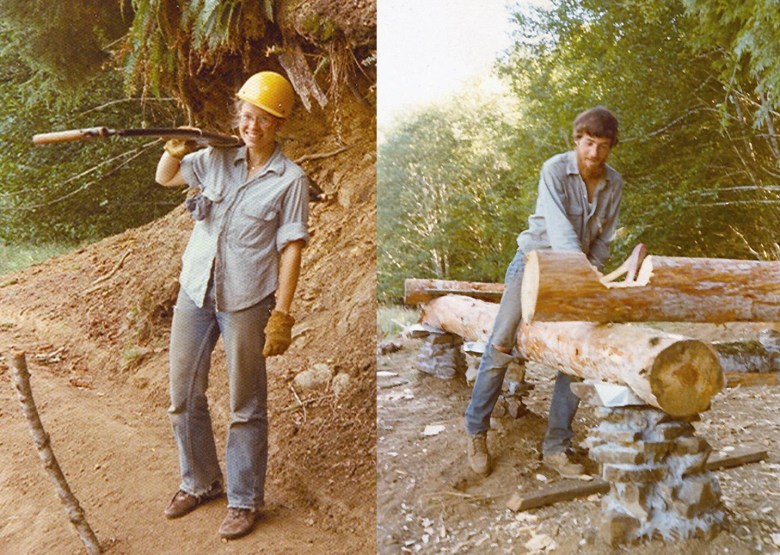
Here’s what I wrote in my journal about cutting the cabin’s first tree:
“Well, it looks easy enough,” I said, opening a pamphlet on log cabin construction to a chapter entitled “TIMBER-R-R-R!”
Janell eyed me from across the picnic table in our campsite. We were lingering over a breakfast of oatmeal mush. Now that the log cabin foundations were finally finished, I had spread out the drawings of our planned one-room summer house, along with the literature we had assembled on the subject: a copy of Henry David Thoreau’s “Walden” and an extension service pamphlet on “Building a Log House” from the University of Alaska.
Janell sighed. “I’ll get the hard hats if you do the dishes.”
I could tell she was not entirely at ease as she got out the crosscut saw. The blade flopped around like a wounded shark, bristling razor-sharp, two-inch teeth.
I quickly rinsed the dishes and took the saw across my shoulder, pointing the teeth out where they could bob without harm. “Ready?” I asked.
“Aren’t the first logs supposed to be the heaviest?” Janell bit her lip.

“Let’s practice on some smaller trees first.”
“Good,” she said.
The trail I had built from the cabin site switchbacked steeply up a ridge into a dense hemlock forest. Sword ferns and salmonberry bushes rose from a thick bed of moss like green sea creatures in an underwater grotto, dimly lit by a distant sky. About 100 yards above the cabin site I stopped at what appeared to be a stand of telephone poles.
“A doghair thicket,” I announced.
“A what?”
“That’s what they call a place where the trees are as thick as the hair on a dog.”
“I hate to kill any of them,” Janell said.
“It won’t hurt the forest to thin a few. How about this one?”
The tree I had pointed out was about 10 inches in diameter and rose perhaps 80 feet in the air. Janell peered up at it. She sighed and nodded.
With the ax I scored a line around the trunk where the cut would go. Then I added an extra line for a V-shaped notch on the downhill side.
“Why mark two cuts?” she asked.
“If we just saw straight through, the tree will settle onto the blade. We’ll cut a wedge out first the way we want the tree to fall. Then when we cut in from behind, the whole thing is supposed to pivot down on this hinge in the middle. I saw it on TV once. They had a logger who could aim the tree so well that he set up a stake 100 feet away and made the tree drive it into the ground.”
Janell is less talkative when she is nervous. The thought of felling this very heavy tree clearly worried her. In silence we set up the saw, each holding one of the handles at either end. After we had jerked the blade back and forth for a minute with little effect, she bit out the words, “Don’t push. Pull.”
Sure enough, when each of us took turns pulling, the blade sailed through the wood like a serrated knife through French bread. Bright curls of sawdust flew from the notch, accompanied by the sweet rich scent of fresh lumber. In another few minutes we had sawn out the wedge — a slice of cantaloupe bouncing merrily down the hill — and we were already well into the final cut in back.
Then a breeze swayed through the forest. Our tree tilted downhill, creaking ominously. We both jumped back, startled. After a breathless moment the breeze shifted directions. Slowly, incredibly, our tree swayed back until it was leaning at a frightening angle directly over our heads. I ducked behind another trunk. Janell looked up at the tree with wide eyes and began crab-walking frantically uphill through the moss.
But then the breeze passed and all of the trees straightened up, including ours. For a long time neither of us was willing to get near enough to finish the cut. By now our 80-foot tree was attached only by an inch-thick hinge of wood in the middle. If it chose to defy our careful wedge-hint and drop on us, it could squash us like bugs, hard hats notwithstanding.
“Let’s pick a different tree,” Janell suggested.
“We can’t leave this one here like this.”
We approached the tree as warily as if it were a grizzly bear on a tether. I dug in my heels to prepare for a sudden 80-foot dash. Every stroke of the saw now made the tortured tree groan, snap and creak. The trunk swayed woozily, like a lamppost in front of a drunken man.
Finally the tree gave a small shudder. “Timber!” I cried, jerking the saw free. We raced for cover, our hearts pounding. The tree tilted slightly downhill, enough to show that it had been sawn entirely through. But then it merely nestled against the shoulder of a neighboring tree and stayed there, seemingly satisfied, as if it didn’t care that it was no longer attached to the ground.

After a long silence, Janell said, “That’s what we get for cutting trees on the back of a hairy dog.”
I ventured forward, gave the severed tree a shove, shouted “Timber!” again, and ran for cover. The tree slowly bounced against its neighbor’s branches, but did not fall. Before long I was back at the tree, yanking and kicking at the trunk. When this accomplished nothing, I looped a rope around the trunk as high as I could reach, walked downhill, and tried to pull the tree down.
“Bill!” Janell objected. “It could fall right on top of you.”
As far as I could tell the tree didn’t seem interested in falling anywhere.
“Wait, I’ve got an idea,” I said. Using the blunt end of the ax as a maul, I pounded the trunk off of its stump. But as soon as the trunk slipped free, it rammed itself 18 inches straight down into the forest duff, planting itself as firmly as if it were a pier pounded in by a pile driver. The tree looked as if it had been growing there all its life.
Janell gently lifted a patch of moss from the forest floor and placed it on the stump to hide the scar we had made. “Let’s find another tree.”
“No!” Now I was out for vengeance. “We’re going to cut this one down again.”
“Again?”
“Sure. The cabin will need some short logs on either side of the door. If we cut this one off waist high it’ll come out just about right.”
The second time we cut down the tree the job really was easier. Neither of us was alarmed when the severed trunk stuck into the ground as before, refusing to fall downhill.
By the third time we cut the tree down, we felt like old hands at this kind of work. And so it took us by surprise when the tree really did tilt loose from its doghair neighbors, rip through the branches like a battleship launched into the woods, snap in half as it crashed across a gigantic old stump, and thump in two pieces onto the forest floor, splintering an elderberry tree.
We looked up at the little hole of daylight that had opened above our heads. Then we looked at the two halves of the broken tree.
“I guess I didn’t aim it very well,“ I said. “That stump it hit must have been left from when this place was first logged 70 years ago.”
“Look at the size of it,” Janell marveled. The ancient rotten stump stood 10 feet tall and swelled nearly 10 feet wide at the base. Square notches remained where the early loggers had inserted springboards. Standing on those bouncy, narrow platforms they had been able to saw through the trunk above the root swell, where it was only 6 feet thick.
Suddenly our struggles with a mere 10-inch-diameter tree seemed puny. In fact, our entire forest shrank as we stared at the ancient stump. Once these hills must have been crowned with giants, the pillars of a great green hall in the Skookums’ world of myth.
These days we do have a chainsaw at the log cabin. But sometimes I still use the old crosscut saw for felling firewood. Cutting down a tree is a delicate business. It is in fact an art.

