
 Trying to add a payment method? You can do this on the
I’m generally not a fan of California-style ultralight backpacking, where tents consist of a 37-gram hammock. It rains in Oregon. Hypothermia is a real danger. You need gear that will keep you warm and dry.
Still, when Janell and I assembled our packs for a three-day backpacking trip recently, I was dumbfounded to discover that my pack weighed just 20 pounds. Janell’s pack weighed a mere 13 pounds. This is half the weight of packs we carried a few decades ago.

Gear has gotten lighter over the years. Storm-proof tents, freeze-dried food and down bags are all ultralight now, compared to when I began backpacking as a 5-year-old kid in the late 1950s.
The sport was fashionably new back then, and there were no REI outlets in Oregon. Everyone bought their gear at G.I. surplus stores. World War II was recent history. Surplus stores were everywhere. Tents were made of canvas. They were impossibly heavy unless you had a horse, so you planned to stay in shelters.
I remember camping in three-sided shake huts in the high Cascades. Only a few of those shelters remain. I can testify that those open-sided shelters were fun during the day. At night, however, they were smoky, cold and full of mosquitoes.
For trips to places without shelters my father bought pastic sheeting to tie up as a makeshift tarp. That was a miserable mess in the rain.

My backpack was a Trapper Nelson model, consisting of a canvas bag attached to a wooden frame with grommets and metal rods. The thin shoulder straps were unpadded. There was no hip belt.
Even less comfortable was the giant backpack my father proudly devised for himself — a rubberized gunny sack tied to a metal frame that had been used in World War II to carry rocket grenades.
The bulkiest gear attached to my pack was my sleeping bag, a rectangular flannel-and-canvas sandwich manufactured by Coleman. On chilly nights I renamed that brand “Cold man.”
The food my mother prepared for our trips would have tasted awful if we weren’t eating it in the woods. The Mountain House company in Albany had not yet been assigned by NASA to invent freeze-dried ice cream for moon missions, so for dinners Mom brought Uncle Ben’s converted rice. To this she added hamburger, precooked into dry crumbles and packed in tin foil.

Breakfast was pancakes, with batter made from a Krusteaz mix. Mom fried this over a campfire on a thin metal skillet that left the pancakes burned on the outside, gooey in the middle. Instead of syrup, we sprinkled brown sugar on top.
And then everyone took the wires out of their Trapper Nelson backpacks and used them as skewers to roast Little Smoky sausages over the campfire. They were greasy and spicy and revolting.
Backpacking lunches, on the other hand, haven’t changed much over the years. The fad in my youth was GORP, an acronym for granola, oatmeal, raisins and peanuts. That still works.
The clothes modern backpackers wear have perhaps changed the most. As a kid my usual outfit consisted of high-topped Converse tennis shoes, blue jeans and a nonwaterproof coat. Outdoor clothing now is synthetic, light and efficient.

To be honest, I still sometimes wear jeans on the trail. I know, I know — people say “cotton kills,” but you don’t actually see that many dead hikers in denim.
Recently I led a hike for an upscale Portland group, the Multnomah Athletic Club. One stylish young woman asked me what I liked best about the sport.
Perhaps because I couldn’t afford to join her club, I told her I liked hiking because it’s egalitarian. Anyone can do it without expensive special clothes.
She responded, “What do you think all this shit is I’m wearing?”
Taken aback, I said that hikers really only need to bring the 10 Essentials.
She sniffed, “I only need two essentials — cell phone and credit card.”
This is why I don’t earn the big bucks by endorsing gear for outdoor companies.
I’ll admit that I carry a few new items in my backpack these days. For example, backpackers now have to bring a water purification pump. Because giardia parasites spread to mountain streams in the 1970s, it’s no longer safe to dip a Sierra cup into a creek for a drink. You also need a camp stove. Campfires are banned in the high country, both to limit fire danger and to leave campsites looking natural.
Another new item is a solar charger. Janell and I use this to recharge the phones we now use instead of real cameras. As for the folding camp chairs, that’s simply a concession to tired backbones.
Are there more people hiking in Oregon these days? Yes, but there aren’t that many more backpackers. Even with ultralight gear, carrying camping equipment isn’t easy. In the afternoon the daytime crowds return to their cars. By evening, only the backpackers remain.
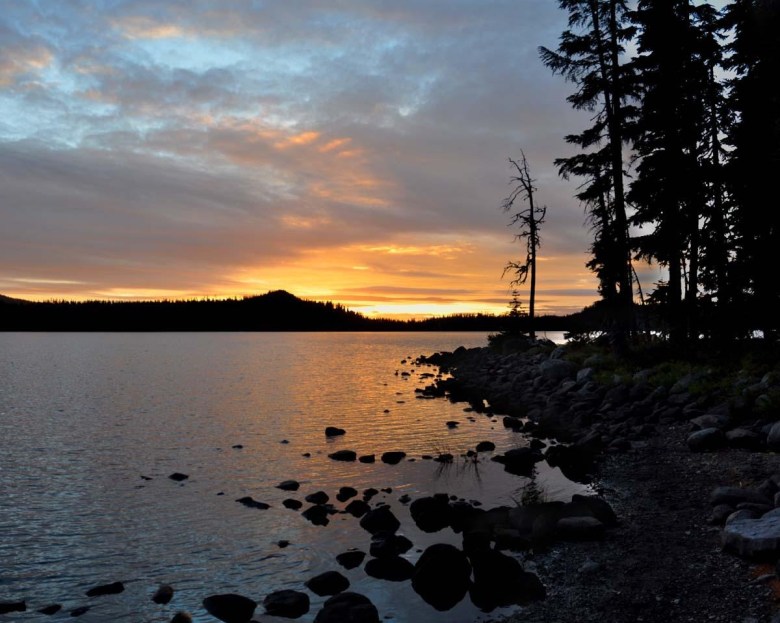
Only they, in glorious solitude, get to watch the sunset turn the mountains pink, reflecting water bars in a silent lake.
Times change. The gear you take changes. But Oregon is still Oregon.

