
 Trying to add a payment method? You can do this on the


QuickTake:
As Lane County struggles to get a site approved for its big recycling facility, a Eugene company sits and waits to deploy its technology. And a trash hauler’s practice of trucking waste 170 miles away to avoid fees is releasing tons of greenhouse gases.
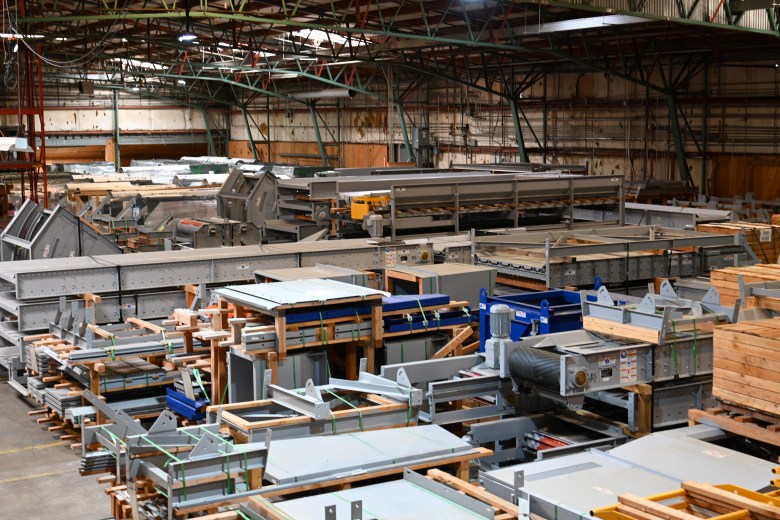
Inside a cavernous warehouse in Eugene, stacks of equipment sealed in plastic wrapping are propped atop crates, ready to be installed.
Throughout the 50,000-square-foot building are conveyors, motors and equipment with artificial intelligence that can detect and sort recyclables.
The equipment was supposed to go into Lane County’s new CleanLane recycling facility, scheduled to open this year.
But construction is yet to begin.
And so technology that would offer advanced tools to increase the county’s recycling rate and divert at least 80,000 tons of trash per year from Short Mountain Landfill sits and collects dust. The technology also would reduce climate-warming greenhouse gas emissions from decomposing waste.
Instead, truck traffic from haulers taking garbage to a dump outside Lane County pumps out even more pollution.
And the long-planned CleanLane facility continues to face setbacks, delays and obstacles.
The county has unsuccessfully tried to acquire a special use permit to allow CleanLane to be built in Goshen. There are now two prospects: County officials are now trying to locate CleanLane at Short Mountain Landfill and hope to fend off an appeal filed by the project’s opponents. And the Goshen site remains in the mix, through a potential code amendment that would allow the project.
Bulk Handling Systems, a Eugene-based company, owns the equipment stashed away in the warehouse. The company reached an agreement with the county to build and operate CleanLane in Goshen. Steve Miller, the chief executive officer of Bulk Handling Systems, said the project can work in either location.
For now, Miller is waiting for a land-use hearing officer to make a determination after hearing the appeal of the county’s permit application to put the project at the landfill. The county applied for a special-use permit to place CleanLane at Short Mountain Landfill, which the planning director granted. A land-use hearing officer will now decide upon the merits of the appeal, which was filed by the Lane County Garbage and Recycling Association and seeks to reverse the approval.
That decision is due in mid-October. From there, though, the issue can continue to be appealed by either side to the state’s Land Use Board of Appeals.
The county’s waste management ecosystem faces other complications beyond land-use challenges. Sanipac, a trash hauler owned by Texas-based Waste Connections, takes much of its trash out of Lane County to a Waste Connections-owned landfill near Medford, in Jackson County.
In the past, county officials have expressed concerns that the practice undercuts the CleanLane project and the amount of trash it needs to pencil out financially.
Sanipac’s decision to haul trash to Jackson County means that it does not pay fees to dump trash at the Short Mountain Landfill. Those fees, not taxes, pay for Lane County’s waste management system. With a decline in revenue, county officials have cut hours at transfer stations where residents in rural areas can drop off their trash. The county also shut down one of its 15 transfer stations to close a budget gap.
The county has offered Sanipac a discounted rate of $100 per ton, down from the current rate of $112.46, for a five-year period to drop its waste at Short Mountain Landfill. The county has yet to get an answer either way, a county spokesperson said.
In a statement, Sam Jefferies, a spokesperson for Sanipac, didn’t directly address the company’s receptiveness to the county’s offer but defended its environmental record and decision-making process.
“Sanipac entered into its agreement with the Dry Creek Landfill after considering all available information,” Jefferies said in an email. “Based on what was known, Dry Creek presented a more environmentally and fiscally sustainable option than what was offered in Lane County, which has allowed Sanipac to limit rate increases for its customers in Creswell and elsewhere in the county. Sanipac has repeatedly joined other haulers in calling on Lane County to commit to real transparency. Until it does, the company will continue to operate with the best data available.”
Yet others say Sanipac also needs to be upfront with its customers.
Miller, with Bulk Handling Systems, said the broader backdrop creates questions for Sanipac.
“Can they do it? Sure,” he said. “Is it the right thing to do? Does it benefit this community where their customers are?”
“That’s a question that ought to be answered. Is there an environmental consequence to it? Are you emitting carbon by sending diesel vehicles two-and-a-half, three hours down the road one way?” he said. “Sure there is. So those are questions they’ve got to answer.”
1.5 million miles to and from the dump
In 2025 alone, vehicles taking trash out of Lane County logged nearly 1.5 million miles — the equivalent of driving from New York to Los Angeles and back, at least 250 times.
The climate-warming greenhouse gas pollution from those trips is about the same as 850 gas-powered cars each making that coast-to-coast round trip.
Lookout Eugene-Springfield conducted an analysis of haulers bypassing the local Short Mountain Landfill and heading to Dry Creek Landfill, a round trip of about 348 miles.
Lookout’s analysis is based on a model of heavy-duty trucks with trailers carrying literal tons of trash.
Last year, more than 107,000 tons of household waste came from Lane County to the Dry Creek Landfill in Jackson County, according to Department of Environmental Quality records.
That’s about twice as much as in 2024, and nearly eight times as much in 2023.
That timeline fits major developments for waste management in Lane County:
Around 2021, Sanipac started to transfer locally collected solid waste to EcoSort, a sorting facility in Springfield that also takes trash from Cottage Grove Garbage Service. Waste Connections owns both Sanipac and Ecosort.
In 2022, Waste Connections acquired Rogue Disposal & Recycling, a company that owns the Dry Creek Landfill.
In 2023, Lane County officials signed a $150 million contract with Bulk Handling Systems for the CleanLane project, which is to be paid through landfill fee increases across a four-year period, not property tax revenues.
In 2024, Short Mountain was a top emitter of greenhouse gases in the county, releasing 155,251 metric tons of carbon dioxide equivalent — a measure that combines carbon dioxide with other heat-trapping gases, such as methane. The six-figure emissions figure is about the same as its average over the last decade.
Bringing those emissions down is part of the goal of CleanLane.
Meanwhile, as the project stalls, the long haul south adds another source of greenhouse gas: about 1,926 metric tons of carbon dioxide equivalent.
Lookout Eugene-Springfield shared its estimates with Sanipac, which did not dispute them. According to Sanipac, the company is testing and operating one electric vehicle.
How we did the model
At every step, Lookout Eugene-Springfield made conservative estimates, rounding down numbers.
Data: The Department of Environmental Quality collects information on solid waste. According to their numbers, 107,000 tons of municipal solid waste came from private haulers and transfer stations in Lane County to the Dry Creek Landfill in 2025. According to county officials, none of it came from county-owned facilities.
The starting point: The analysis measures from Dry Creek to Glenwood, where EcoSort has its location in Lane County and takes municipal solid waste.
The math for mileage and tons: The round trip from Glenwood transfer stations to Dry Creek Landfill is 348 miles.
Trucks observed leaving the transfer stations in Glenwood — that are not compactors — are medium-to-heavy duty. The trucks that the county uses to take trash from transfer stations to Short Mountain are similar. Trade publications say they carry 15 to 25 tons per load.
Lookout divided the 107,000 tons by the maximum load of 25 tons, for about 4,280 trips. At 348 miles per round trip, that’s nearly 1.5 million miles in a year.
The math for emissions: The EPA estimates about 1.3 kilograms in greenhouse gases per mile, averaged across loaded and empty trips.
At 348 miles per round trip, that’s about 450 kilograms per trip. Multiplied by 4,280 trips, the total is about 1.9 million kilograms, or roughly 1,900 metric tons of greenhouse gases in 2025.

Mason Leavitt, a GIS analyst and programs coordinator with the environmental nonprofit Beyond Toxics, first flagged the tonnage numbers to Lookout Eugene-Springfield, which verified them through DEQ records and independent analysis.
Leavitt has spent years watching how waste decisions in the Willamette Valley play out from communities that live with them, such as the Coffin Butte landfill near Corvallis, site of a controversial expansion proposal. Now, he has his eyes on Lane County, private haulers, and the CleanLane project.
“Sanipac’s motivation seems to be profit, and the consequences of their actions is that they are undermining what is a really good investment in preventing pollution and enhancing recycling outcomes,” Leavitt said.
Sanipac, in its response, said it has implemented residential and curbside recycling years before Oregon law required and has expanded its collections to include yard debris, food waste and co-mingled recycling.

Risks and rewards
In the past, county officials have also expressed concerns that shipping the waste out of Lane County would undercut the CleanLane project, as the county’s contract with Bulk Handling Systems requires a minimum amount of tonnage — 120,000 tons annually — to pencil out financially. If the county falls short, financial penalties kick in that the county has to pay to Bulk Handling Systems.
But Miller, Bulk Handling Systems’ CEO, says he believes the county can hit that 120,000-tons mark, based on the latest numbers at the county’s Short Mountain Landfill.
“I’m not concerned,” MIller said. “The county now, even with Sanipac taking waste to their landfill in Jackson County, they still have enough to meet the minimum, and they’re above that.”
County officials agree.
In 2025, the county had 112,188 tons from commercial haulers and it believes it could put additional trash from its transfer stations toward that threshold, said Devon Ashbridge, a Lane County spokesperson.
Ashbridge added that no waste collected at county-owned facilities is being transported out of Lane County.
The county has blown past contracted deadlines, which called for construction to be finished or nearly finished in 2025, with equipment installation and commissioning this year.
Under the contract, the county faces a financial risk if the project isn’t built on schedule. It’s a $12,000-per-day fee, or nearly $4.38 million per year.
The county hasn’t started to pay any late-fee yet and so far, it’s not become an issue. The county maintains the delays are due to land-use appeals and not its fault.
Asked about that provision, Miller said the goal is to get the facility built in a cooperative way.
“We want to see the facility built,” he said. “We signed the contract with that intention. The county wants to see the facility built. They signed the contract with that intention. We think it’s the wrong thing to do to argue with your customers in a negative way. … We want to be as cooperative as we can be.”
For Bulk Handling Systems, the Eugene project would offer a place for it to showcase its work. The company has a global footprint and has built similar projects from Europe to California.
Miller said the project is important for the region.
“When you think about Oregon, all of the more significant facilities are in Portland because the population’s there, and because of population and generation of material, there really isn’t anything in this part of the state,” he said.
At CleanLane, trucks will come in with waste and the technology will identify and remove recyclable and organic waste. The organic waste, such as food and paper, will be processed to produce renewable natural gas for transportation fuel.
The company’s technology can screen and sort materials, using artificial intelligence, optical imaging and other tools. That includes separating two-dimensional objects like paper and plastic bags from three-dimensional objects like containers and milk jugs.
Optical sensing identifies them based on their molecular content. This helps sort materials that are usually recyclable but may be too messy to separate from waste.
The CleanLane project, if built, would extend the landfill’s life by another 20 years because it diverts materials away from it, county officials estimate.
The facility will be able to run at 55 tons an hour, Miller said.
And while the materials can be separated from waste, he said the company is not suggesting that people stop separating their recyclables from trash. That’s because recyclable materials can still get contaminated and not be usable if organic matter like food soaks into it.
For example, a cardboard box soaked in pizza grease may not be suitable to recycle as a new box.
While artificial intelligence gets a lot of attention, Miller said the company deploys other technologies as well.
Miller added: “None of our robots are going to at one moment stand up and start, you know, taking over the world.”
There also are economic benefits if the project is built. During construction, nearly 200 people will need to be hired.
Bulk Handling Systems has about 300 employees, 200 of them in Eugene. With the Lane County project, 68 additional full-time employees would be at the facility.


