Trying to add a payment method? You can do this on the

QuickTake:
The trustees also asked staff to look into issuing a revenue bond to help cover PERS costs and welcomed a new student trustee.
Suggested revisions to the Lane Community College Board of Education’s public-comment policy drew mixed reviews at the board’s Wednesday, Oct. 7, meeting, and trustees tabled the proposal.
The board also gave LCC staff the green light to investigate issuing another bond to help reduce the college’s Public Employees Retirement System costs.
Board members also welcomed a new student member, while honoring the outgoing student member — who had sharp words for trustees.
Public comment
A subcommittee led by board member Kevin Alltucker worked on the public-comment proposal. One recommendation would cut the time allocated to each speaker from three minutes to 90 seconds at meetings when more than 40 people have signed up to speak. Board policy now trims that three-minute time limit to two minutes when more than 20 people want to speak.
Part of the idea is to minimize meetings such as one held in November 2025, when 63 public comments took more than two hours and pushed the meeting to nearly five hours — delaying consideration of other agenda items until later in the night.
Alltucker said the proposed revisions would allow everyone who wanted to speak the chance to do so. He said the subcommittee preferred that option over setting a hard time limit on public comment — the way the Eugene City Council, for example, generally allows only 90 minutes of comment at each meeting.
Jerry Rust, the board vice chair and subcommittee member, said he encouraged public comment.
“Nevertheless, there will be times when you have to manage the number of people who want to speak to the board,” he said.
Other board members had questions about another part of the proposal dealing with written comments and how it would work in practice. One suggested revision calls for those written submissions to be “acknowledged” during each meeting. Board member Zachary Mulholland questioned the staff time required to track written comments and how submissions would be acknowledged during the meeting, noting that doing so also could extend a meeting’s running time.
And some of the speakers during the meeting’s public-comment portion criticized the proposal.
“Our fundamental freedoms are at stake at the current moment,” said the evening’s first speaker, Jay Smith, who termed the proposal to limit speakers to 90 seconds during certain meetings “laughable.”
Smith and other speakers said the proposal “illustrates the disrespect that this board, specifically certain members of the board, have toward the freedom of speech.” They cited a recent case in which LCC student Richard Riordan, a frequent critic of board actions, was barred from campus and blocked from registering for classes until Dec. 31, 2099, on grounds that he posed a threat.
Riordan filed suit, and U.S. District Judge Michael J. McShane, finding that his lawsuit demonstrated “a likelihood of success on the merits,” ordered LCC to let him register for classes and allow his access to campus for academic purposes. He is not to attend board meetings in person.
In his Sept. 28 ruling, McShane wrote that Riordan’s criticism of LCC is “at times annoying, long-winded, aggressive, hyperbolic, and grandiose. Yet, while we live in a world where public officials face very real threats, the attempt by the defense to profile the Plaintiff as a serious threat to the community is equally hyperbolic and grandiose.”
The next hearing on the lawsuit is scheduled Oct. 26.
The board will revisit the public-comment policy at a later meeting.
PERS account
Board members gave LCC officials the go-ahead to explore issuing another revenue bond to assist with its Oregon Public Employees Retirement System costs.
One of LCC’s so-called PERS “side accounts” is expiring, which could result in a sharp uptick in the amount of money that must be pulled from the general fund or other accounts to pay pension costs. In these side accounts, a district typically sells bonds and the invested funds are sent to PERS as a side account; money earned on the investments helps lower a district’s rate.
Board member Steve Mital reminded trustees that, although LCC’s side accounts have paid off for the college, any investment carries risk — and urged caution.
“It’s just an important thing to remind everybody here that, ultimately, this is a gamble. … This becomes, essentially, one of the most consequential, and essentially risky, things that we as a board do. So we should all go into it with that mindset.”
LCC officials said they would return to the board with recommendations, but added it would take at least three months to work through the options.
Student trustees
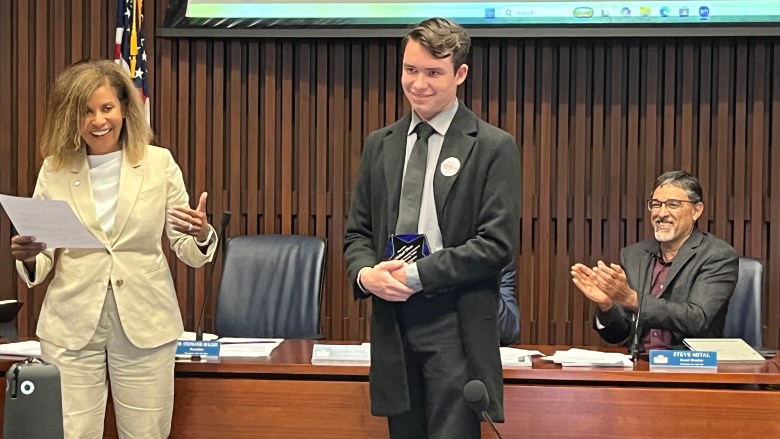
The board welcomed Constantine Hadley, the new president of the Lane Student Government Association, as the board’s student trustee.
And it honored Michael Olson, the past president, who has completed his one-year term as the student trustee. (The president of the student government serves on the board as a nonvoting member.)
“You have been a committed and active voice for Lane students,” LCC President Stephanie Bulger told Olson. “You’ve consistently emphasized the importance of including students in decisions affecting their education, and you brought their perspective into the board discussions.”
Olson later spoke during the meeting’s public-comment period, and said he intended to be “the constant reminder” to board members to be respectful and to emphasize communication — and added that, in his view, the board has a “documented past of disrespect” to students, including the proposal to limit public comment at some meetings.
“You’re telling us, the students, effectively to ‘shhh’ and that we’re talking too much by bringing people forward to a meeting,” he said. “Disrespecting your students really just needs to end.”
As for communication, Olson noted he was not told by anyone that he was to be honored at Wednesday’s meeting — and only learned about it by checking the meeting agenda.