Trying to add a payment method? You can do this on the


QuickTake:
Trained in Eastern Orthodox iconography, Olga Volchkova has a keen eye for the unspoken relationships in nature. She spends weeks researching and months painting them.
Last spring, Olga Volchkova spotted a candy cane plant in the Oregon woods, near the coast. In late September, she went back and found 10 matsutake mushrooms.
The candy cane flower can’t make its own food, so it takes sugar from the pines through a fungal network beneath the forest floor, Volchkova said. Where it blooms in spring, matsutake follows in fall.
“The experiment was complete,” Volchkova said.
That kind of environmental relationship is the subject of her new exhibition, “Forest Communities,” at Karin Clarke Gallery in downtown Eugene. It includes a depiction of her “experiment,” where the two species are holding hands, showing their interconnection. It’s titled “Saint Allotropa and Saint Matsutake,” allotropa being the scientific name for the candy cane plant.
Her paintings depict the many connections among species in Oregon ecosystems, from milkweed and monarch butterflies to the alder trees that keep invasive species from crowding out conifer saplings.
A background in iconography
Volchkova tells these stories in a form she learned before she came to Oregon: icon painting.
“That was my first profession,” she said.
Volchkova was born and grew up in Tver, in the former Soviet Union, and attended both art school and iconography school.
At iconography school, she learned how to paint religious icons, divine events and sacred beings through traditional techniques.
“In one school I was learning restoration, and in another school I was actually learning icon painting technique. So it was perfect,” she said. When the Soviet Union collapsed and the economy fell apart, she said she was able to find paying work restoring artwork for churches and private collectors.
She also worked with a small religious community, painting for churches and traveling across Russia. She said she was never religious, and eventually left that community because she wanted to choose her own subjects.
“I could not do it anymore because the subject was not mine,” she said.
Now, choosing her own subjects, iconography still shapes her work, but instead of painting saints, she’s showing how species depend on one another, with plants and animals depicted in classical iconography style.
She also uses carved surfaces and gold leaf to give scenes of ecological connection a luminous quality.
In one painting, “Saint Red Alder,” red alders guard a forest, creating conditions for young cedar and Douglas fir saplings to take root.
In “Saint Kelp Forest,” she portrays Oregon marine biologists as “superhero[es]” defending kelp habitat from sea urchins, alongside octopus and sea otters, which feed on the urchins.
“What’s happening right now on the Oregon coasts is that the kelp forest is disappearing because of global warming,” Volchkova said. Warmer water helps sea urchins breed faster, “and they eat it so fast that it’s really disappearing. Not just in Oregon; it’s pretty much all over the [world].”
Time-consuming work
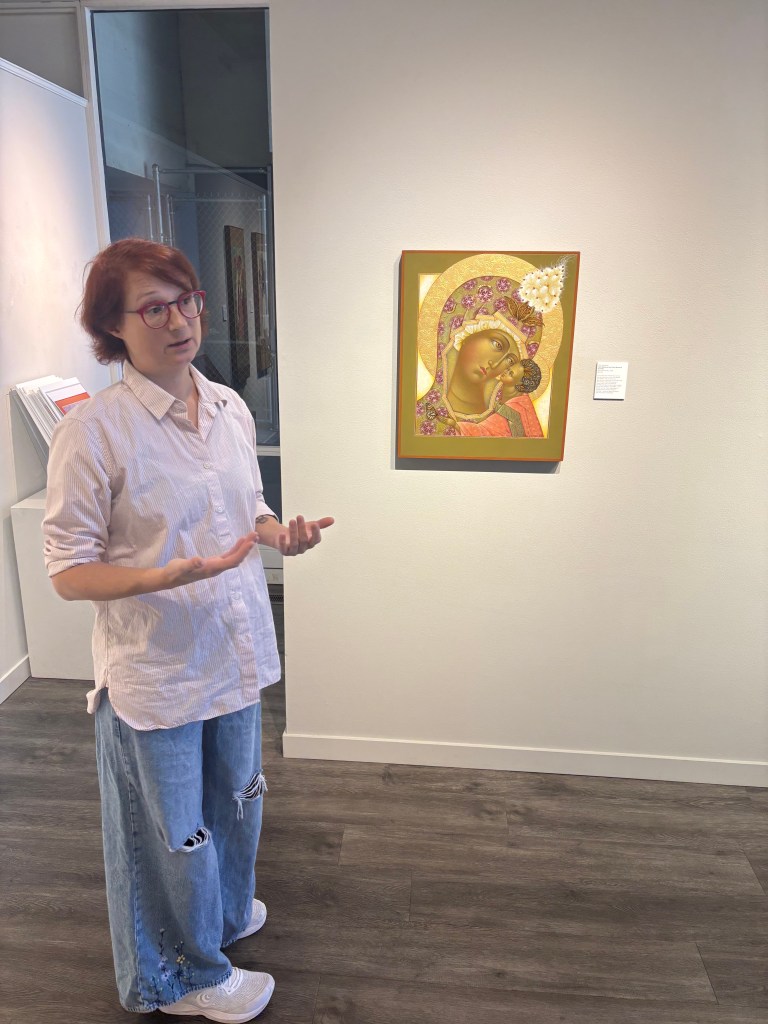
Her connection to the woods started early. She learned to forage for mushrooms and berries with her grandmother, who lived in a small village in the Soviet Union.
“My favorite thing is foraging for edible mushrooms,” Volchkova said. “That’s what we did when I was growing up. I lived in a kind of self-sustained village, and my grandma and I would go to the woods and pick berries and whatever else was in season.”
The work is time-consuming. Karin Clarke, owner of the gallery, said Volchkova’s paintings take more time than those of any other artist she shows, and that a full solo exhibition represents years of effort.
“It won’t be uncommon for her to paint for a 12-hour day,” Clarke said.
The research behind each piece is also demanding. Volchkova reads about each species, watches documentaries and walks the woods near her home. She says she knows far more about the natural world than she did a decade ago.
She moved to the United States in 1998, first to New York, then to California, where she worked in the tech industry building early websites. She and her husband eventually settled in Eugene.
“Both New York and the Bay Area, to get to real nature, you really need to drive for a long time,” she said. “Here it’s a 15-minute walk from home, and you’re in the woods.”
That proximity keeps feeding her inspiration for her work.
“Nature is an endless source of inspiration, and when you start to dig deeper, there’s even more there,” she said.
If you go
“Forest Communities” runs through Nov. 28 at Karin Clarke Gallery, 760 Willamette St. in Eugene. The gallery participates in the First Friday ArtWalk from 5:30 to 7:30 p.m. on Nov. 6.
You can find more of Volchkova’s work on her website.