
 Trying to add a payment method? You can do this on the


In the movie “The Goonies,” a group of kids from Astoria discover a pirate map that leads them to One-Eyed Willy’s treasure in a hidden sea cave. The film is a goofball classic, but it’s based on the genuine legend of a shipwreck at Neahkahnie Mountain.
A 2022 expedition discovered remnants of a ship there.
On the northern Oregon Coast between Tillamook and Cannon Beach, Neahkahnie Mountain is an inspiring place, where the Tillamook tribe believed their most powerful god resided. The name Neahkahnie comes from their words Ne (place of) and Ekahnie (supreme deity).
Today a trail climbs 1.5 miles to a spectacular summit viewpoint. Might you stumble over a treasure chest if you hike there? And what happened to the ship?
I’ll tell you about the hike in a moment, but first let me explain the legend.
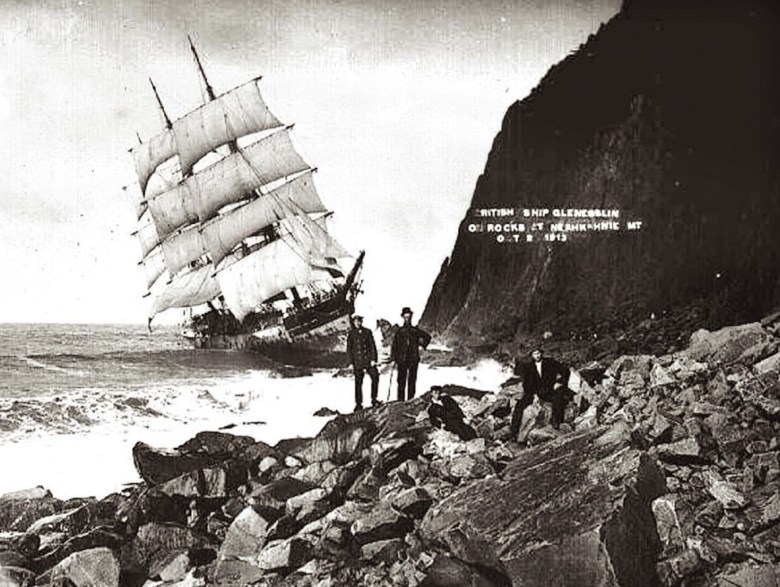
The most widely circulated story describes an early Spanish wreck on the Nehalem spit at the base of Neahkahnie Mountain. Thirty survivors made it to the beach, ferrying the ship’s treasure ashore in a longboat.
The men dragged the treasure chest up onto the mountain’s slopes and dug a hole. Then the captain shot or drove away the crew members who wouldn’t fit in the ship’s longboat, and he ordered the remainder to row him back across the ocean toward Mexico.
By 1870 a gold digger named Pat Smith had become so infatuated with the legend that he married a Clatsop woman to get inside information from the tribe. In 1890, Smith’s excavations revealed several strange boulders, now on display in the Tillamook County Pioneer Museum.
The rocks are inscribed with arrows, crosses and the letters “DEW.” Smith believed they were coded directions to the treasure site.
Additional clues include fragments of Chinese pottery and chunks of beeswax that keep washing up on the beach. One large piece, stamped with the number “67,” is on display at the Tillamook museum.

In 2007, a team of 20 researchers announced that they had narrowed the identity of the missing ship to one of two Spanish galleons, the Santo Christo de Burgos, lost in 1693, and the San Francisco Xavier, lost in 1705.
The search narrowed to just the Burgos when researchers determined that beeswax and chips of 17th century Chinese pottery were not found above sediment from the tsunami that struck the Oregon Coast in 1700.
The ship was finally found by Craig Andes, a commercial fisherman and scuba diver from Astoria. A longtime fan of “The Goonies,” Andes decided to look exactly where the movie said it would be. So he put on his scuba diving gear and explored sea caves at the base of Neahkahnie Mountain.
In one of them he discovered old timbers wedged into cracks. He alerted the National Geographic Society. They sent a more formal expedition. After a salvage operation in 2022, the timbers were brought to the Columbia River Maritime Museum in Astoria for study and preservation.
Lab tests revealed that the timbers are from a tropical hardwood tree felled in Asia in about 1650. Researchers concluded that the wreck really is a Spanish galleon — and specifically, the Santo Christo de Burgos. Only the tsunami of 1700 would have had the power to ram the ship into the cave and scatter debris inland across the Nehalem estuary.

So where’s the treasure? To answer this you need to know why the ship was carrying so much beeswax.
The Spanish Empire built Catholic churches throughout most of Latin America. Locals were encouraged to buy candles to burn in the churches to honor saints. Priests forbade the use of lard candles because they would blacken the church. They allowed only beeswax candles.
Problem: South America has no native bees that produce wax.
This is not a problem, however, if you’re the Spanish Empire. Asian bees in the Philippines produce lots of wax. And so, once a year the Spanish would load up a galleon with gold from South America and silver from Mexico, and sail it to Asia. First stop would be China, where the gold and silver would be traded for silk and porcelain. Then the galleon would stop in the Philippines to fill the rest of its hold with beeswax.
These galleons were extremely valuable and quite large, with as many as 300 passengers and crew, so careful records were kept. The Santo Christo de Burgos was one of only two ships that went missing. Because it was returning from Asia, it would not have carried gold or silver. The only treasure on board would have been silk, pottery and beeswax.
Digging for treasure is no longer allowed at Neahkahnie Mountain. The real treasure there is the hike.
If you go

Drive Highway 101 north of Tillamook for 28 miles to a turnoff between mileposts 41 and 42. Look for a brown sign with a hiker symbol on it, opposite Sunset Drive. Turn inland here on a gravel road for 0.4 miles. Park beside the road before a locked gate.
The trail starts near an outhouse 0.1 miles before the gate. Steep switchbacks climb up through meadows 0.9 miles to a ridge-top junction. Continue straight on a path that contours 0.6 miles around the wooded back of the mountain before emerging at the summit meadow viewpoint, the recommended turnaround point.
Portions of this column first appeared in William L. Sullivan’s 2014 book “Hiking Oregon’s History.”

