
 Trying to add a payment method? You can do this on the


Today people play disc golf in Milo McIver State Park, southeast of Portland. It’s a great place for a woodsy hike along the Clackamas River. But in 1970 this sleepy park was the site of the nation’s first and only state-sponsored rock concert, when 35,000 young people came here to party while state police looked the other way.
First let me tell you about “Vortex I: A Biodegradable Festival of Life.” Then I’ll try to lure you to the park itself for an easy hike or a bit of disc golf.

In the depths of the Vietnam War in 1970, Gov. Tom McCall had a problem. Anti-war protesters had been active in downtown Portland, but the American Legion announced it was planning its national convention in Portland anyway — with President Nixon as guest speaker. The FBI warned that protesters might tear the city apart.
Should McCall defend Portland by calling in the National Guard? Already that year the National Guard had been asked to confront an anti-war rally at Kent State in Ohio. The guardsmen there had shot four protesters dead.
McCall opted instead to sponsor a rock festival for the same dates as the veterans’ convention — but 20 miles away in a forgotten state park. A year earlier, in 1969, the Woodstock concert had drawn nearly half a million young people to a farm in upstate New York. Could the governor create a similar “vortex of peace” in Oregon?
McCall’s gamble was huge. If the rock festival was a flop, or if it became a drug-fueled crime scene, his reelection campaign would go down in flames.
Vortex organizers tried to hire nationally known bands, including the Grateful Dead, Santana and Jefferson Airplane. To no avail. Instead they signed up a half-dozen local groups nobody had ever heard of.
It didn’t matter. When McCall announced that state police wouldn’t make arrests for nonviolent crimes, conservative politicians howled — but young people began showing up at McIver State Park in droves.
The state built a stage in a large upper meadow. Meanwhile the Riverbend picnic area became an impromptu tent city nearly a mile long. There were no commercial vendors. Instead nonprofits and alternative groups set up booths. The founders of the Rainbow Family met there, opened a booth and chose their group’s name. Organic groceries and co-ops provided free food for thousands.
Nudity and marijuana smoke were everywhere. But no one died. There was no serious violence.
In Portland, Nixon didn’t show up for the American Legion convention after all, sending his vice president, Spiro Agnew, instead. Fewer than 1,000 people protested in Portland’s streets. The only damage was a single broken window.
The following November, McCall was reelected by a landslide.
Today McIver State Park is a quiet place to take a hike and perhaps reflect on the “vortex of peace.”
Janell and I camped there recently while researching trails near Portland for my hiking guidebooks. As usual, our first stop at the campground was to chat with the volunteer host.
The host was a sandy-haired 60-something in a golf cart. From Oceanside, Washington, he volunteered at a different Oregon state park each year because “they’re the best in the nation. Oregon’s parks actually have funding.”
He knew nothing about Vortex. “I’ve only been here a few weeks,” he said, adding, “It’s good you didn’t show up last weekend. Every campsite was booked.” Apparently the park hosts a national championship for professional disc golf. The Riverbend picnic area, site of the Vortex tent city, now has a world-famous 27-hole disc golf course along the river.
The host said he picked up a wayward disc, handed it to its owner, and said, “Here’s your Frisbee.”
The golfer bridled. “Correction. It’s not a Frisbee. It’s a disc.”
The host apologized and retreated. But a volunteer colleague whispered to him, “It’s a damn Frisbee.”
Modern discs are weighted with precision. Knowing stuff like that is why professional disc golfers earn the big bucks.

Having chatted with the host, we found our campsite and began to set up. One of my jobs had been to choose a tent from our laundry room shelves. We have several tents. I chose one — but I forgot that the poles came in a separate bag.
Many spouses would flip out when they discovered this. Janell is the best. “It’s not supposed to rain,” she said.
I managed to string up the top of the inner tent from a tree branch. With the four corners staked out below, it formed a saggy tepee that would keep out bugs, but nothing else. Janell rolled out our sleeping bags inside without comment.
The tent camping area was nearly empty, so nobody came by to laugh. A pity really, because I had rehearsed my response: “It’s the Ultralight Poleless A-Frame method. Or don’t you know?”
The next day I set out to explore the park’s trails. Most of the trails wander through viewless woods, but I found two nice, easy loops with a lot to see.
You will need to buy a $10 parking pass at the park’s entry booth. If you’re bringing a dog, plan to keep it on a short leash.
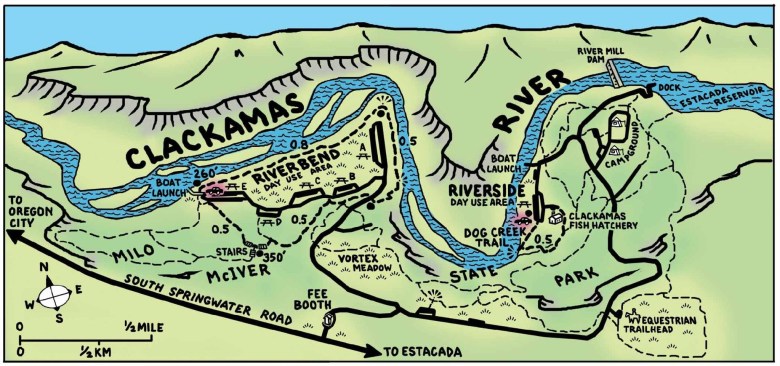
Start with a half-mile nature trail to the Clackamas Fish Hatchery. This loop would be great even with small children in tow.
Park at the far end of the Riverside Day Use Area’s long parking lot and set out on the Dog Creek Trail. After just 0.1 miles, a short spur to the right leads to a cobble riverbank beach popular with fishermen and wading kids.
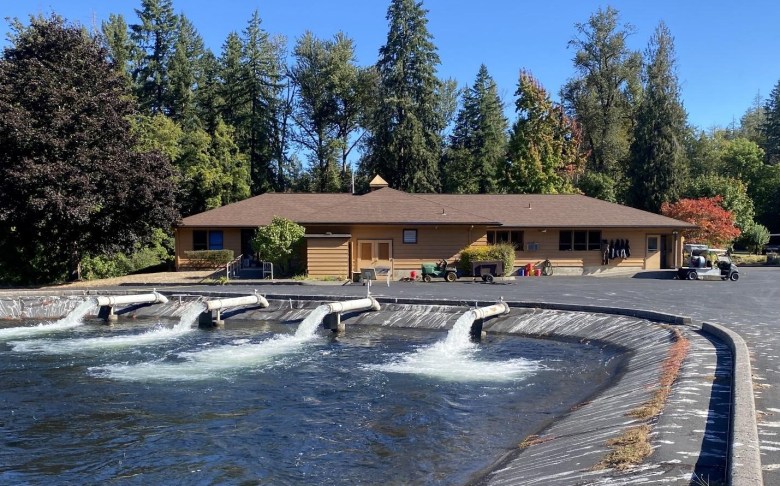
Next the loop trail heads upstream along Dog Creek. The creek seems as big as a river here because it’s the outflow for the fish hatchery’s ponds. After crossing a long footbridge you’ll enter the fish hatchery grounds. Zigzag past the fish tanks to the back door of a one-story building with a small visitor center. Then go out the front door and turn left along park roads to return to your car.
The other recommended loop is 2.3 miles, circling the disc golf course that once was a Vortex tent city. Drive west across the park to the other huge picnic destination, the Riverbend Day Use Area. Five parking areas are labeled from A to E. Drive to the far end of the last lot, Picnic Area E.
There’s a gravel boat launch here, but this is also the start of the Riverbend Trail Loop. The path follows the riverbank to the right, tracing the edge of the disc golf lawns.

Wait, but where was the Vortex festival stage? It was set up in a meadow halfway back to the park entrance. The road passes the site — but without 35,000 screaming young peace-loving music fans, it’s just not the same.
If you go: Drive Interstate 205 to Oregon City exit 10. Turn right on Washington Street to loop underneath the freeway. Then, at a traffic circle, exit onto Clackamas River Drive. Follow this scenic road along the river 5.5 miles to a stop sign beside a bridge. Go straight on South Springwater Road for 9.3 miles and turn left into Milo McIver State Park’s entrance road. Stop at a fee booth to pay the $10 parking fee with a card. In another 0.4 miles, you’ll reach a junction with a stop sign. The Riverside Day Use Area is to the right, while the Riverbend Day Use Area is to the left.
For the first recommended hike, turn right for 2 miles, and then keep left to the far end of the Riverside Day Use parking lot.
For the second recommended hike, turn left toward the Riverbend Day Use Area and keep left for 1.6 miles to the far end of the last picnic parking area, labeled “E.”

