
 Trying to add a payment method? You can do this on the


With just a few weekends left in summer, it’s time to hit the beach — and ride a free trolley to free hiking trails near Yachats.
Did I use the word “free” twice in that opening sentence? Yes, because scenic trolley rides aren’t usually free. Neither are most of the hiking trails at Cape Perpetua, where parking your car usually requires a $5 permit.
This summer the coastal town of Yachats is running a quaint green trolley on a loop every hour from Beachside State Recreation Site (5 miles north of town) to the Cape Perpetua Visitor Center (3 miles south of town), Thursdays through Sundays.
You can hop on for free at any of 17 stops. Then you hop off wherever you like by pulling the “Request Stop” cord. The trolley has a rack for bicycles and a lift for wheelchairs.
Perhaps the best part is that you don’t have to wait around, wondering when the next trolley will show up. The “Trolley Tracker” shows where it is in real time.
I’m going to give you three hiking recommendations that involve the trolley.
This is a limited-time offer, so act fast. Yachats runs the trolley only in summer, from Memorial Day weekend through Labor Day weekend. I’m told they can’t operate the trolley during the school year because the trolley drivers are then working as school bus drivers.
Trip 1: Leave your car in Yachats, ride the trolley to the Devils Churn at Cape Perpetua, and take an easy half-mile hike to a hidden beach without worrying about parking permits. From the parking area at the Devils Churn, a paved trail zigzags down a few hundred feet to a viewpoint of a long lava slot where waves slosh.
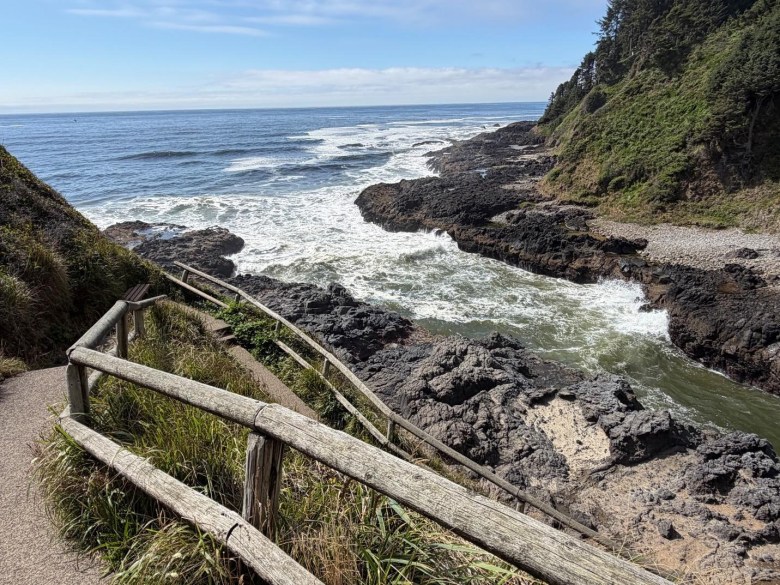
From the viewpoint, follow a paved trail to the left, through the gnarled windswept forest of a scenic headland. This path visits a very beautiful beach that’s not visible from Highway 101, so it’s usually empty.
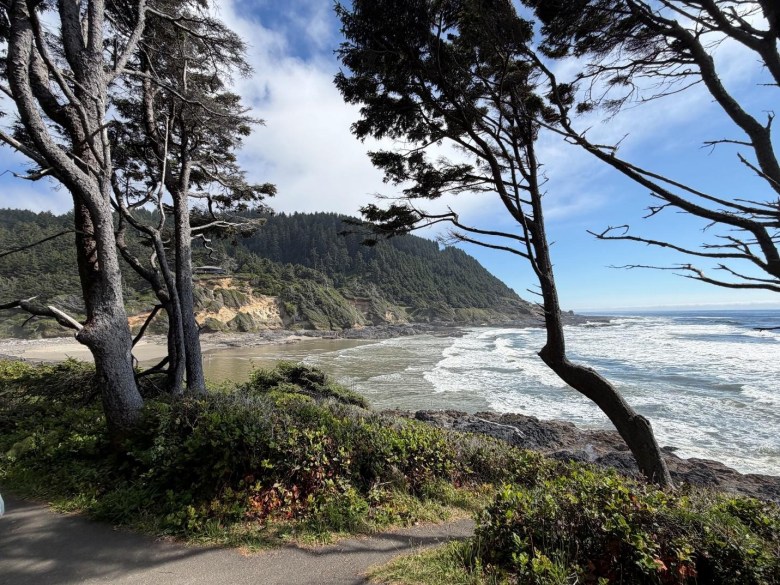
Beyond the beach, follow a path up to the visitor center, where you can watch a movie or look at displays while you wait for the next trolley to take you back to town.
Trip 2: Leave your car in Yachats, take the trolley north 4 miles to its turnaround point at Beachside State Recreation Site, and ride back a mile to get off at Tillicum Beach Campground.
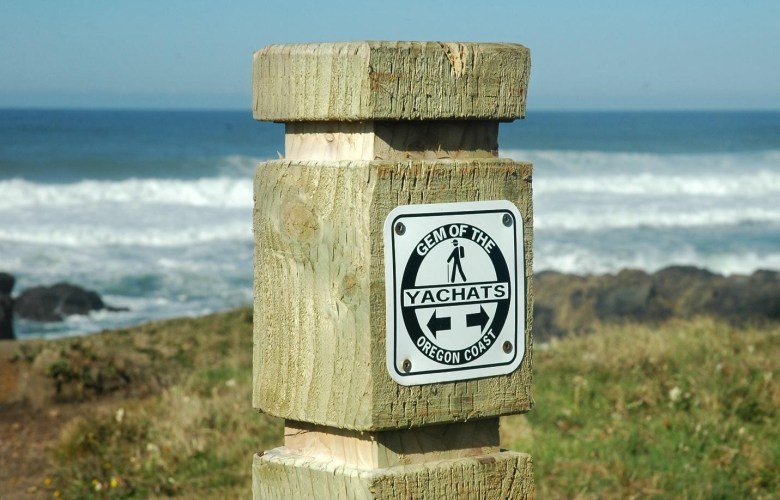
Then walk south on the beach 2.7 miles. When the sand ends, continue on a portion of the Oregon Coast Trail that traces ocean bluffs past motel lawns and cottages for 2 miles back to downtown Yachats.
Trip 3: Leave your car in Yachats, take the trolley to the Amanda statue, and walk 2 miles back to town on a different portion of the Oregon Coast Trail.
For this option, you’ll need to ride the trolley all the way south to the Cape Perpetua Visitor Center and then back one stop. Only in this direction does the trolley pull off the highway at a small, gated dirt road that heads inland.
The trail back to Yachats takes off from the left side of this road. But first take a trail down to the right, where you’ll discover a 142-foot suspension footbridge over a creek. Beside the bridge is a plaza with benches and a 4-foot-tall concrete statue of Amanda, a Native American woman with a tragic story.
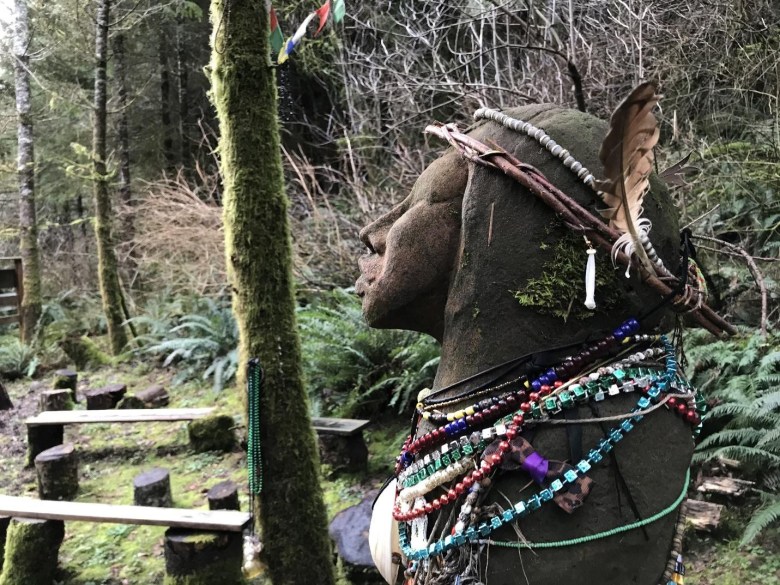
A tribal ceremony with 150 people dedicated the site in 2010.
After the Rogue River Indian War in 1856, the U.S. Army removed the Native people of southern Oregon to a new reservation on the Central Oregon Coast — a wild, trackless area that encompassed most of what is now Lincoln County and western Lane County.
By ship and by forced march, more than 1,400 people were brought to reservation camps at Siletz and Yachats. Those who remained behind were declared fair game for bounty hunters.
Nonetheless, some Native Americans escaped from Yachats to return south to their homeland. In 1864 the Army sent a patrol south to round them up and bring them back to Yachats.
The soldiers found Amanda, an elderly-looking, blind Native American woman, at a farm owned by a white settler named De-Cuys, at the head of tidewater on the Coos River. When the soldiers told her she had to leave, she asked to say goodbye to Julia, the settler’s 8-year-old daughter. To the soldiers’ astonishment, the little girl threw her arms around the old woman and cried, “Dear Mama!”
The soldiers left Julia but took her mother away. They marched Amanda north over sand dunes and lava rocks until her feet were so bloody they left tracks. According to one soldier’s journal, some of the men swore at her, told her to hurry up and threatened to leave her to die.
History does not record how long Amanda survived in Yachats, or if she ever saw her daughter again. But by the time the Yachats agency closed in 1875, disease and neglect had reduced the population there by half.
After paying your respects at the Amanda statue, walk the 2 miles to Yachats.

Yachats has become a busy summer getaway, full of tourists eating halibut sandwiches and ice cream. Ride the trolley to slip away from the crowds. Then take a quiet hike to honor the natural beauty, and the history, of Yachats.

