
 Trying to add a payment method? You can do this on the

In a hot summer when headlines are aflame with reports of wildfires, it’s easy to think that fires are all bad. For years, that’s what Smokey Bear told us. As the climate warms, the fire season seems to get longer and more devastating.
The history of forest fire research tells a more complicated story. Allow me to explain.
Indigenous peoples and pioneers alike set fires on purpose to manage the land. For the native tribes, fires in the Willamette Valley improved deer hunting, promoted the growth of willow shoots that could be used for basketry and renewed fields of edible camas bulbs. In the hills, fire improved hunting, renewed beargrass sprouts for basket weaving and expanded huckleberry fields.

Pioneer farmers praised the Willamette Valley prairies as an Eden, but that grassland existed only because fires every few years had killed the encroaching fir trees. Similarly, Central Oregon’s park-like groves of ponderosa pine were so inviting because fires had burned along the forest floor every five to 25 years, tidying things up. Eastern Oregon’s grasslands, which fed a boom in cattle and sheep in the early 1900s, existed only because wildfires killed the junipers and knocked back the sagebrush every few years.
When the Forest Service took over the newly created National Forests in 1905, fire management was the hottest issue of the day. One faction of foresters argued that small, low-level fires improved soil fertility and prevented catastrophic fire. Another group felt that all fires were destructive and dangerous.
The anti-fire faction emerged victorious after the Great Fire of 1910. That year, a record-setting blaze in Idaho and Montana torched three million acres and killed 86 people. In the backlash that followed, more than 8,000 fire lookouts were built to watch for smoke, including 849 lookouts in Oregon. By 1935, the Forest Service had adopted a “10 a.m. policy” to put out all fires by mid-morning on the day after they start. Roads and airplanes became part of the battle plan.

Meanwhile, the Forest Service launched a campaign to re-educate the public about fire. A psychologist hired by the Forest Service in 1939 analyzed the traditional use of low-level fire and announced that it represented the “defensive beliefs of a disadvantaged cultural group.” A Forest Service movie, “Trees of Righteousness,” warned in Biblical terms of “demon fire.” By World War II the anti-fire slogans had shifted to patriotic themes, such as “Careless Matches Aid the Axis.”
By far the most successful Forest Service anti-fire campaign began with the creation of Smokey the Bear in 1944. The advertising mascot, later identified with a fire-scarred cub at the National Zoo in 1950, was so widely loved that his popularity rating eventually exceeded that of the president. Coordinated with “Keep Green” campaigns in individual states, Smokey targeted children with great effect. Human-caused fires dropped 50 percent between 1950 and 1980.
But other voices were questioning the anti-fire strategy. Harold Weaver, for one, warned in 1943 that fire suppression was changing central Oregon’s ponderosa pine forests in dangerous ways. A government forester, Weaver had graduated from what is now Oregon State University. He noticed that dry branches and brush were piling up on the forest floor throughout central Oregon. Thickets of young trees were also choking the understory. If a fire did start, he predicted it could flame up from the new tinder on the ground, explode through the new thickets of small trees and torch the crowns of the old ponderosa pines, killing everything.
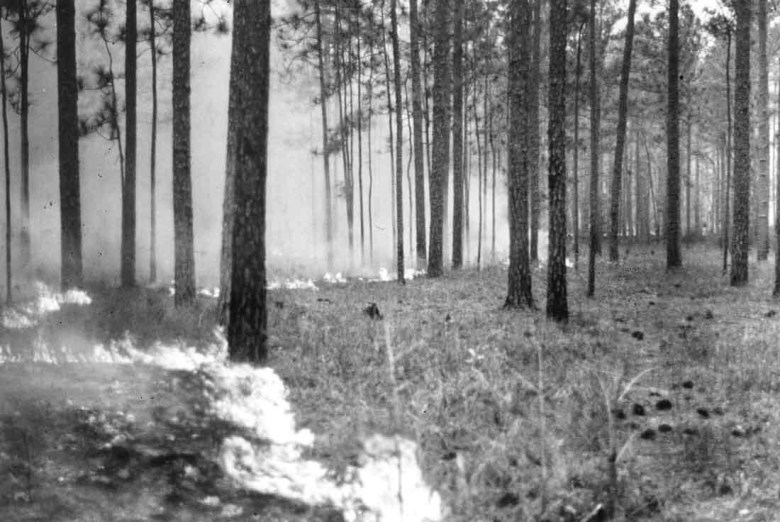
Ponderosas are normally wizards at surviving fire. The outer layer of their thick bark can flake off during a blaze, shedding heat. Older ponderosas rise limbless for 30 or 50 feet to keep their needles safely above the reach of ground fires. By eliminating small fires, Harold reasoned, the Forest Service was stocking the woods with fuel for catastrophic burns later.
A National Park Service report on Yellowstone in 1963 found many of the same problems Weaver had noticed in central Oregon. In 1969, the National Park Service began letting some natural wildfires burn. The new policy recognized fire as a natural part of forest health, reducing fuel supplies and making way for new growth.
The public was a little suspicious when the National Park Service introduced “prescribed burns,” where rangers actually set fires. A ranger explained at a biological sciences convention in Oregon that the goal of the National Park Service had “progressed from a protection of natural objects to a protection of natural processes.”

By 1971 the Forest Service had begun changing its attitude toward fire, too. They edged Smokey the Bear toward retirement by introducing a new mascot, Woodsy Owl. But Smokey’s ringing challenge, “Only YOU can prevent forest fires!” was not easily displaced by Woodsy’s slogan, “Give a hoot, don’t pollute.”
Biologist Richard Vogl echoed the public’s mood in a 1973 article for the Saturday Review:
“Who could believe, as we sat securely in mother’s lap and listened to the story of Bambi, that we were being pumped with a great deal of nonsense? Who could mistrust the honest-looking, clean-cut man wearing a green uniform and badge who visited our fifth grade and told about Smokey the Bear and the destruction wrought by forest fires?”
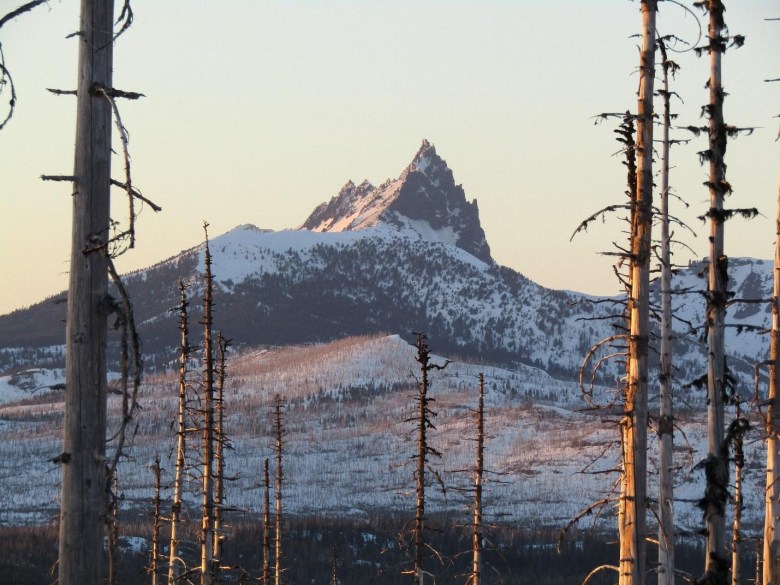
In Oregon, the reluctance to embrace wildfire went deeper than memories of Smokey the Bear and “Keep Oregon Green” posters. Oregonians had learned to fear fire because of the recurring nightmare of the Tillamook Burn, a series of fires in 1933, 1939, 1945 and 1951. More recently, the firestorms of 2020 leveled communities up and down the state.
As the climate warms, fire is changing our forests. Oregon will look more like California, with pines instead of firs, and California will look more like Baja California, with cactus.
Maybe Smokey was right after all.

