
 Trying to add a payment method? You can do this on the

QuickTake:
Ask me about any wilderness in Oregon, and I will be able to suggest several prettier, quieter routes than the overtrodden PCT.
On a recent backpacking trip into the Diamond Peak Wilderness, Janell and I stopped for lunch in a lovely alpine meadow near the Pacific Crest Trail. While she sketched in her journal and I wrote for an hour or more, a solitary PCT hiker would trudge past every 15 minutes or so.
All of them had two hiking poles. Their sticks leave rows of punch marks on either side of the tread. You can’t tell them apart at a distance, beneath their hats. They have the same determined gait, focused on the trail, never taking photos, except, I suppose, of themselves at trailhead signs. Their thoughts seem far away, perhaps on their next food supply drop.
What a luxury our laziness seemed, sitting on a log by a meadow lake for hours at midday, reveling in the scenery as they marched past.

Janell says journaling at times like this is the best way to remember a beautiful place, to note all the details that you might otherwise overlook — the gnarled cracks on a standing snag, the shapes of snowfields clinging to cliffs, the crooked snow-bent saplings, some of them 5 feet tall and 50 years old.
Later, her journal will bring back all the memories, from the piney smell to the errant mosquito.
The PCT was built as a bypass in the 1960s — sort of a wilderness freeway, avoiding the most sensitive, beautiful places.
In the Sky Lakes Wilderness south of Crater Lake, for example, the PCT visits no lakes at all. The old Oregon Skyline Trail, built through that same area in the 1920s, visits 40 lakes.

You can still hike many parts of the older, more scenic Oregon Skyline Trail from California to Washington along the length of the Cascade Range, although there are gaps and lost sections.
The name Oregon Skyline Trail is no more, replaced by numerous local trail names. To find the old route, simply follow the trails that meander from lake to lake, from shelter to shelter, from meadow to meadow along the Cascade crest. The Oregon Skyline Trail was built for rangers on horseback. They stopped at lakes and meadows and shelters.
The PCT has to be open to horses, but it now avoids meadows as much as possible. Instead, it’s been routed through viewless woods.
At Crater Lake, no pets or horses are allowed on the rim, so the PCT goes low, bypassing all the viewpoints on Crater Lake’s rim. The same thing happens at Mount Hood — the Timberline Trail goes high while the PCT has to go low, missing out on alpine scenery.
When I was in the Siskiyou Mountains recently I told a PCT hiker that she could come 20 feet off the trail to a viewpoint where she could see a lake with a campsite and a fresh spring.
She said, “I’m on the PCT.” Then she marched on.
For PCT hikers like Cheryl Strayed, who wrote the bestseller “Wild,” hiking the PCT is presumably an inner voyage. The trip is not really about the land; it’s about the hiker. I get that, I guess.
To research my guidebooks, I’ve hiked more than 1,000 trails in Oregon. The Pacific Crest Trail is by far the most famous of them. It attracts people from all over the world. It attracts people who have never hiked before at all.
Ironically, I’ve found the PCT to be one of the least scenic and most crowded trails around. Ask me about any wilderness in Oregon, and I will be able to suggest several prettier, quieter routes.
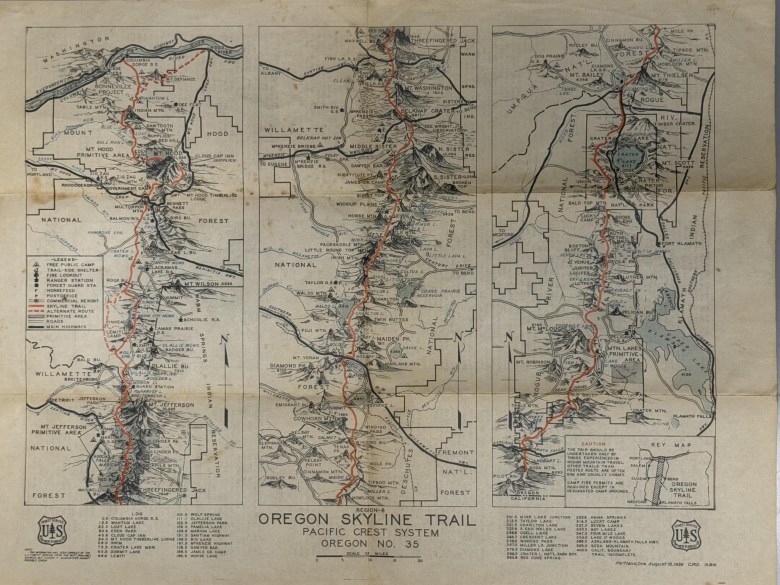
Even if you’re determined to hike the length of the Cascade Range, surely it would be more challenging to explore the quiet old sections of the Oregon Skyline Trail.
Here it is late August, the peak of the summer hiking season, and I’m not posting mile-by-mile accounts of my PCT progress on Instagram.
Now you know why. I’m relaxing in an alpine meadow, writing notes in longhand while Janell draws in her sketchbook. We are not hiking the PCT.

