Trying to add a payment method? You can do this on the


QuickTake:
The mural project was in part funded by a grant from the Lane Arts Council. Participants are encouraged to approach the mural in unique ways, from pencil etchings to painting.
Jamal Foreman uses neon-pink and green paint markers to draw pyramids on canvas leaves inside a community space at the Roosevelt Boulevard Safe Spot.
It’s one of 12 safe spots managed by Community Supported Shelters, a nonprofit focused on helping unhoused people rebuild their lives.
Paint-smeared paper plates are scattered across the table next to Foreman, where six other residents work on their own leaves, each in a different style.
Foreman said he takes inspiration from graffiti but wants to give it a positive twist.
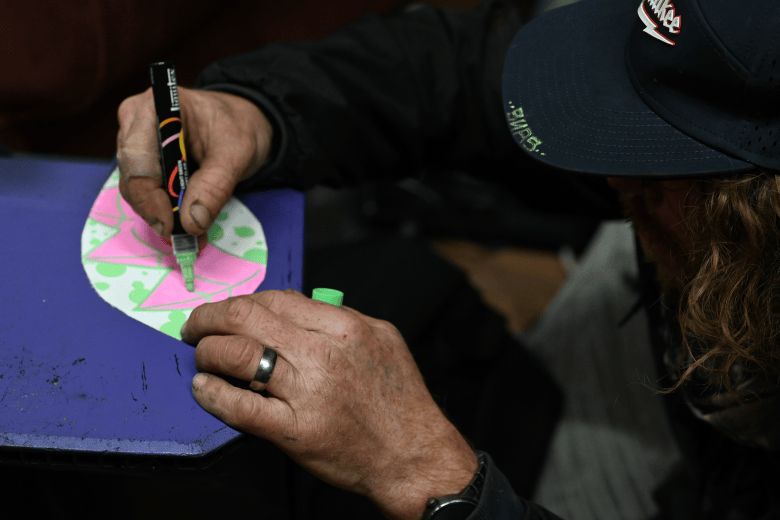
“A lot of the graffiti around town is super negative, like curse words and stuff,” Foreman said. “So I said, here’s something more positive: a couple of neon pink pyramids.”
Participants are painting sections of a larger tree design, and can choose their own colors and approach. The project is funded by a grant from the Lane Arts Council and is part of a two-site effort by Community Supported Shelters to use collaborative art to build community among clients.
Art as work restoration
The Roosevelt space also shelters people in Eugene’s Community Court, a program mainly for low-level offenses like trespassing or graffiti. Roosevelt helps participants stabilize and take part in the court and its associated programs.
For some, the art project also counts toward work-restoration hours, similar to community service.
Anna Alkin, Community Supported Shelters’ programs manager and coordinator, said not everyone painting needs those hours. The organization has offered other activities, including cooking and educational programming, but this is the first time it has made art the focus of work restoration.
The project is a “living” mural. Each participant paints one square of a larger design. The squares will be joined into a single piece of canvas hung at the site. When Community Court participants graduate, they will add a leaf.
Boomer Graham, a Community Supported Shelters client, tries to make art as often as he can. His leaf has bright blues and oranges, inspired by the colors of autumn, he said.
“I’ve got a couple of canvases at my friend’s place,” Graham said. “I haven’t put them up anywhere, but I want to soon somewhere.”
Graham also said painting helps him relax.
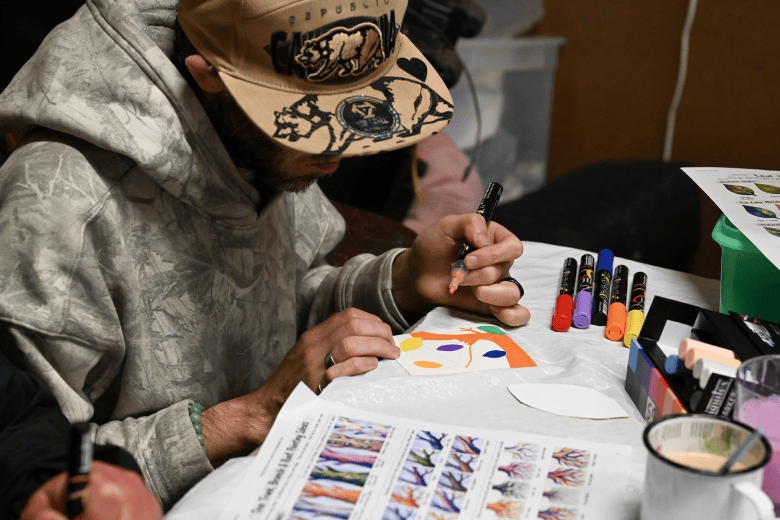
“[Painting] calms me down. It takes the stress away,” he said.
A living mural
Candace — who asked that her last name not be used because she is a domestic violence survivor — is workforce coordinator at Community Supported Shelters.
She designed the tree and is leading the project.
Candace holds a master’s degree in arts education and said the approach comes from her years as a middle school teacher. When a large project is broken into pieces, she said, people who don’t think of themselves as artists feel they can take part.
Candace said art can offer a break from the effort of meeting basic needs.
“The unhoused population spend so much of their energy existing, trying to exist in the world and get their needs met,” she said.
She said the project gives participants a chance to do something they might not otherwise have the opportunity to do. Creating the mural together, she added, is as important as the finished artwork.
For Candace, the work is personal. About a year ago, she was a client of Community Supported Shelters. She went through the organization’s workforce development program and was hired in February.
“It’s very healing for me to go back there to work on this mural,” she said.
The grant and the survey
The mural is one of two. A second, on wood panels and designed to withstand the weather, is planned for Community Supported Shelters’ Empire Pond site, the entry point for everyone who signs up to join a safe spot community.
That project has a different wreath design. In June, the Lane Arts Council awarded $2,250 toward the project, with additional funding from Community Supported Shelters.
Alkin said the grant helps pay for staff time and supplies.
The nonprofit is also surveying participants before and after the project to learn about their sense of belonging, mental health and ability to work with others. Alkin said the Arts and Business Alliance hopes the data can help make the case for arts funding.