
 Trying to add a payment method? You can do this on the


Last week I took you halfway around the Italian island of Sardinia. We visited beaches, castles and the mysterious Nuraghe towers that can only be found on this one Mediterranean island. Because we are on “island time” for this tour, we’ve rested a while before exploring the sea caves and hiking trails on the second half of my recommended itinerary.
In the first week we landed at Olbia, took a ferry to the islet of La Maddalena and visited an archeological museum in Sassari.
Our next stop is Bosa, three miles from the sea on the only navigable river in Sardinia. Bosa was founded by the Phoenicians in 600 BC. The town served as an important trading post for Carthage during the Punic Wars — until Rome finally won the war and conquered Sardinia in 238 B.C.

I love these walkable old towns! Head uphill on narrow streets to find the medieval Malaspina Castle, where a walkway atop the ramparts has panoramic views. Afterward, return to Bosa’s pedestrian-only town square, where a lunch of panini and cappuccino costs just $11. Nearby, you can take a one-hour boat trip down the river to the sea for only $15.
A trip to Italy wouldn’t be complete without a visit to the ruins of Roman city. The best one on Sardinia is a two-hour drive south of Bosa. On an arid stone peninsula, Tharros has temple columns, Roman roads and aqueducts — but it’s not originally Roman.
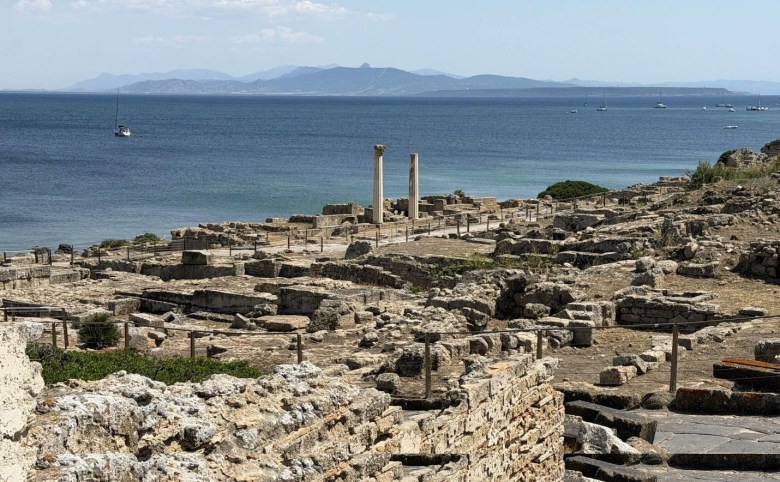
Excavations at Tharros reveal that the Nuraghic culture built towers and houses here before 1400 B.C. Those ruins were overlaid in 600 B.C. when Phoenician traders built a wealthy port, complete with temples to their gods and tombs filled with gold artifacts. In 200 B.C. the Romans built their own, smaller city on top of the Phoenician ruins. By A.D. 800, everyone had moved inland to escape the raids of pirates from North Africa, who sacked coastal villages and abducted inhabitants.
The best hiking in Sardinia is on the east coast, where huge mountains with caves, cliffs and canyons border the sea. Even if you don’t hike, you can experience the wild mountain terrain by driving the winding road from Tortoli to Dorgali – 30 miles of cliff-hanging pavement across two 3,000-foot passes. Stop at the pass Ghenna E Silana to walk on well-marked trails up to a limestone mountain with gnarled cork oak trees.

The town of Dorgali, built on a mountain slope to avoid the medieval pirate raids, has an excellent little archeology museum that charges just $4 admission. For an archeological hike, however, you’ll want to drive a rough road to a poorly marked trailhead (GPS location 40.251 N, 9.491 E) and hike a six-mile loop to Tiscali.
The steep trail to Tiscali switchbacks up a limestone ridge, along ledges, under overhangs and through rock slots. Tiscali is a collapsed limestone cave on a mountaintop. This gigantic pit is the unlikely site of a Bronze Age village where early Sardinians built a hundred circular stone huts, perhaps to escape invading Phoenicians and Romans. It’s now a national park, accessible only by trail.

For the last stop on your trip around Sardinia, head to Cala Gonone, a little tourist seaport surrounded by cliffs. The road there is a tunnel through a mountain. For $45 a tour boat will take you half an hour to Bue Marino, the Grotto of the Sea Lion.
Ironically, the monk seals that gave this cave its name were driven out by fishermen and tourist boats in the 1970s. From the sea cave’s mouth, guided tours every hour follow the limestone cave a kilometer inland, along an underground river, to halls of stalactites.

When you return to the cave’s mouth, a different boat will ferry you at no extra charge to Cala Luna (Moon Bay), where you can hang out in a sandy cave and snorkel in the warm sea. Return to Cala Gonone whenever you like — boats leave for the return trip every hour.
One of the great things about traveling around islands — especially Sardinia — is that life seems to tick along at a slower pace. Tours on the mainland may force you to queue up for buses on a tight schedule. On islands, Janell and I spend hours each day sitting on a balcony or a beach simply writing in our journals.
Last week I attached a copy of the first half of the journal I kept in Sardinia. Here’s the rest of that illustrated notebook. May it inspire you to plan a trip on “island time” as well
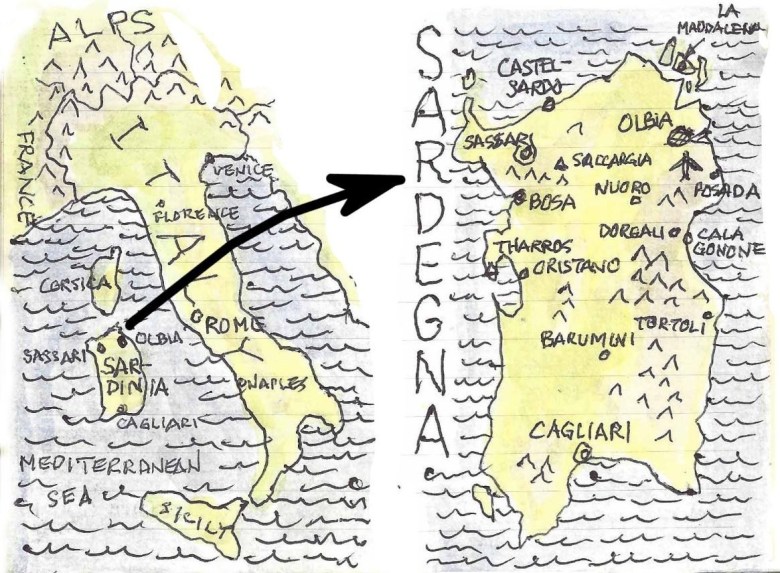
Sullivan likes to go around islands. He drew this map in his journal for his tour of Sardinia. Credit: William L. Sullivan 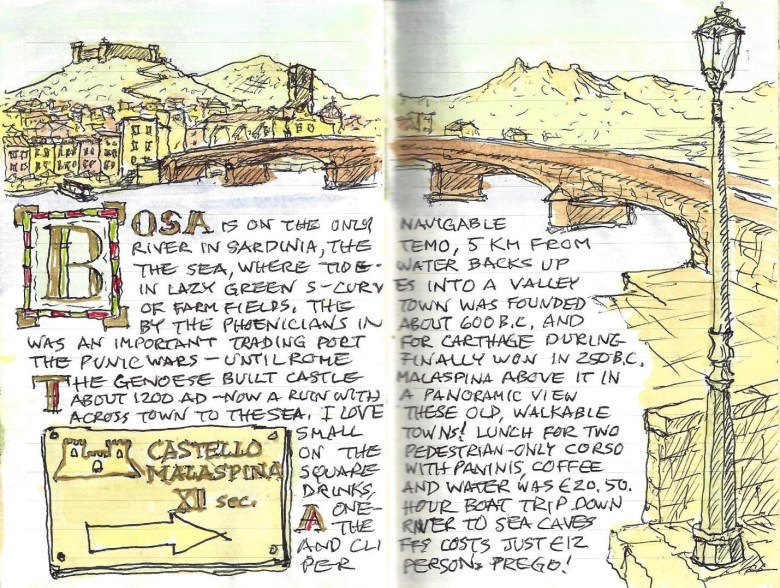
While traveling around islands like Sardinia, Sullivan keeps an illustrated journal of his travels. Credit: William L. Sullivan 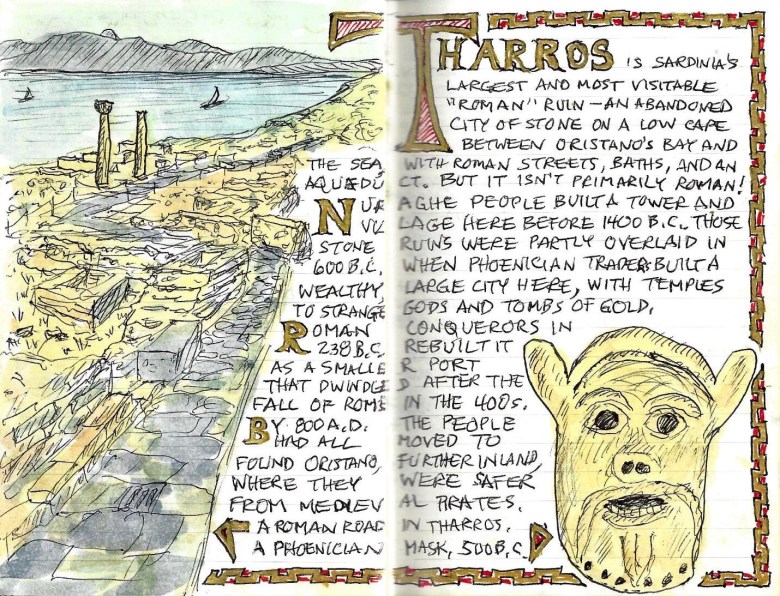
While traveling around islands like Sardinia, Sullivan keeps an illustrated journal of his travels. Credit: William L. Sullivan 
While traveling around islands like Sardinia, Sullivan keeps an illustrated journal of his travels. Credit: William L. Sullivan 
While traveling around islands like Sardinia, Sullivan keeps an illustrated journal of his travels. Credit: William L. Sullivan 
While traveling around islands like Sardinia, Sullivan keeps an illustrated journal of his travels. Credit: William L. Sullivan

