
 Trying to add a payment method? You can do this on the

For the 100th anniversary of Buster Keaton’s 1926 classic, “The General,” let’s take a trip on the railroad line east of Cottage Grove where the movie was filmed.
One of Oregon’s prettiest train routes follows the Row River from Cottage Grove past covered bridges and rustic farms to a reservoir hidden in the Cascades’ wooded foothills. Today the trains are gone, but as part of the “Rails to Trails” movement, the abandoned track has been paved as a 13-mile path for hikers, bikers and equestrians.

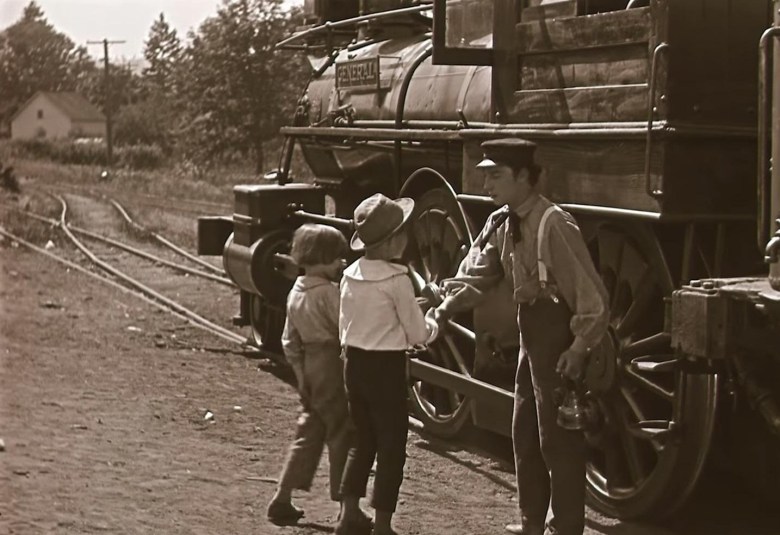
Keaton’s silent film about a stolen Civil War train featured slapstick stunts performed with real steam locomotives. The Row River scenery resembled the Appalachians closely enough that it served well as the backdrop for the movie’s impressive Civil War battle reenactments.
At the high point of the film, a locomotive crashes through a burning trestle into the river. The scene was not faked. Keaton steamed a genuine locomotive into the Row River. You can watch the entire movie for free.
While you’re gearing up for the hike by watching “The General,” you might also pick up the four-and-a-half-star movie “Stand By Me,” filmed on the same tracks in 1986. A darker coming-of-age drama, the film stars River Phoenix as a boy searching for a missing schoolmate believed to have been hit by a train.
Only late night TV now airs a third movie filmed here, “Emperor of the North,” in which Lee Marvin plays a transient person determined to ride the rails on every train in America — including an infamous run guarded by engineer Ernest Borgnine.
The railroad line itself dates to 1902, when Cottage Grove citizens raised the money to build tracks from their city upriver toward the Bohemia gold-mining district. Trains hauled ore and logs out of the backcountry. The railroad company’s original name, Oregon & Southeastern, known as OSE, soon slipped in local parlance to “Old Slow & Easy.”
Perhaps to shake that nickname, the company later reincorporated as the Oregon Pacific & Eastern.
When the Army Corps of Engineers built Dorena Dam in the early 1940s, they moved the village of Dorena out of the reservoir’s way and rerouted part of the railroad track along the new shore. By the 1970s, a steam excursion train called “The Goose” was sharing the line with Bohemia lumber company cars from the Culp Creek sawmill.
After the mill burned in 1991, however, the track fell into disuse. The federal government acquired the line in lieu of $850,000 owed by Bohemia for forfeited timber sale contracts. The Bureau of Land Management converted the route to a gravel trail in 1994 and paved it in 1997.
The entire 13-mile trail is too long for most hikers, but you can sample the best of the route in the first few miles. The drive to the trailhead is also a pleasure, because you’ll pass two of Lane County’s most scenic covered bridges.
The Row River (or Currin) Bridge, along the road a mile before the trailhead, looks like a quaint, 105-foot garage straddling the stream. It dates to 1925, but it replaced a covered bridge built on the same spot in 1883.
Closer to the trailhead parking area, you’ll drive through the Mosby Creek Bridge from 1920, the oldest of Lane County’s 18 remaining covered highway bridges. To sound like a local, pronounce “Mosby” like “Moe’s bee,” and make sure “Row River” rhymes with “cow liver.”
In 1920 it cost just $4,125 to build the Mosby Creek Bridge, a 90-foot Howe truss span, sided in the classic board-and-batten style. In those days bridge-building crews set out with little more than tools, hardware and camping equipment. They felled trees on the spot, cut their own lumber, split their own roof shakes and fished for their dinners.
Why did Oregon’s early bridges have roofs? Of course the covered spans were a welcome shelter for horse-and-buggy travelers in downpours. But the roofs made economic sense, too. When the Row River railroad was first built in 1902, the owners tried to save money by leaving the trestles uncovered.
By 1909, one bridge was already so badly rotted that the timbers gave way, plunging a passenger train car 35 feet into the Row River. No one was killed, but the mishap launched an investigation. The report revealed that the rainy climate had caused the uncovered bridge to rot in just seven years, while a covered span could easily have lasted 40. With that news, covered bridges became the standard.
To find the Row River trailhead, drive Interstate 5 south of Eugene 18 miles to Cottage Grove Exit 174 and follow Dorena Lake signs east on Row River Road for 3.2 miles. Immediately after passing the Currin covered bridge, turn right on Layng Road for 1.2 miles, cross the Mosby Creek covered bridge, and park in a well-marked gravel parking lot on the right.
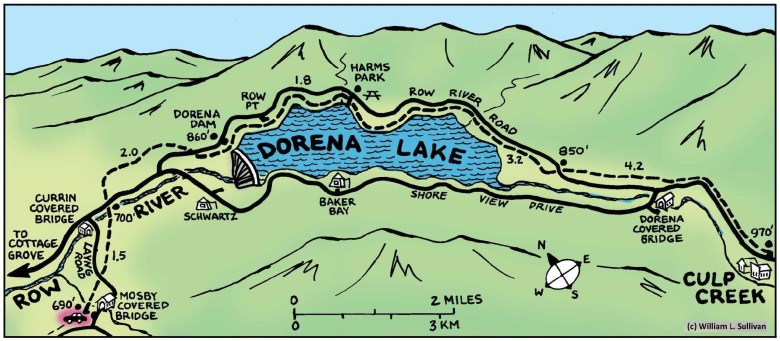
From the trailhead beside the Mosby bridge, the path promptly crosses a red steel bridge over the lazy creek and sets off arrow-straight across flat valley bottomland. Expect giant cottonwood trees, mossy oaks, blackberries, teasels, Queen Anne’s lace, views of grassy oak hills and a few cows looking up from farm fields along the way. The trail itself consists of an 8-foot-wide asphalt strip with a 2-foot gravel shoulder designed for horse use.
After 1½ miles you’ll cross the 100-foot-wide Row River on an impressive steel railroad bridge. This is where the uncovered bridge collapsed in 1909. It’s also near the spot where Buster Keaton’s stunt locomotive took its dive in 1926.

Just beyond the Row River, you’ll cross a paved road and climb for 2 miles through Douglas fir woods to Dorena Dam. Then the trail traces the edge of Dorena Reservoir, with views to forested hills beyond.
After almost 2 miles along the reservoir you’ll cross a footbridge to Harms Park, where the Lane County Parks Department has a gravel boat ramp. This makes a good turnaround point for hikers.
If you’re bicycling, you might want to pedal another 3 miles past Harms Park to where the path recrosses the Row River Road. The path continues 4 miles beyond that point, mostly behind farms or near the road, to its end at the community of Culp Creek.
On a bicycle, the trip back is an easy downhill cruise. With the rural scenery slipping past, you could even imagine you’re riding the Old Slow & Easy on the railroad track that was such an attraction for Hollywood.
Parts of this column originally appeared in William Sullivan’s book, “Hiking Oregon’s History,” published in 2014.

